How to Find an Ethical Meat Source in Traverse City
Ethical sourcing starts with clear answers, not just a label on a package. If you’re looking for a Traverse City ethical meat source, it can be hard to tell what broad claims mean or who produced the meat. The word “ethical” alone doesn’t explain how a farm works. The details matter.
We understand wanting to know where your food comes from and to buy close to home. At Fowler & Valley Farms, we’re a family-owned, multigenerational farm offering beef, pork, and chicken directly to households. You can choose individual cuts, beef boxes, a Build Your Own Beef Box, subscriptions, or local delivery.
In this guide, we’ll cover practical ways to assess sourcing information, compare buying options, and choose cuts or a box that suits your household. From Traverse City to Frankfort, Honor, Benzie County, and Leelanau County, looking beyond broad claims can make the choice more straightforward. The same comparison steps can help shoppers exploring options in Kalkaska, Boyne City, Grand Rapids, Bay City, Midland, Saginaw, Freeland, Clare, Cadillac, Kingsley, Grand Haven, Muskegon, Detroit, and Chicago.
Key Takeaways
- Look for clear, specific sourcing details rather than treating “ethical” as a single, universal label.
- Use practical questions about a farm’s sourcing and products to assess transparency. Being nearby alone doesn’t establish animal-care practices.
- Compare the information farms share, the products they offer, and how directly you can buy from them.
- Finding a Traverse City ethical meat source starts with matching the details you value to a convenient way to shop in Northern Michigan.
- Choose the buying format that suits your household, from individual cuts and beef boxes to a Build Your Own Beef Box or subscription.
What Makes an Ethical Meat Source in Traverse City?
Ethical claims can sound reassuring while leaving you unsure what they mean in practice. A useful way to assess them is to look past broad wording and seek specific information about the farm and its practices. No single phrase will reflect every shopper’s priorities.
Ethical meat sourcing means buying meat from a producer that clearly explains where it comes from and the practices behind it, so shoppers can make choices that fit their values.
When comparing a Traverse City ethical meat source, begin with what you can learn and what each claim actually tells you. A farm’s location may make it easier to identify who produced the meat, but proximity alone doesn’t establish how animals were raised or cared for. Treat origin and animal-care information as separate questions.
What does ethical meat sourcing mean to a shopper?
Your priorities may include animal welfare, how a farm raises its animals, or having a direct connection to the people producing your food. Another household may weigh those concerns differently. Ethical sourcing isn’t one universal checklist. It’s a set of practices you can understand and consider against your own standards.
Animal welfare is one part of that picture. A general framework for animal welfare discusses considerations such as health, comfort, and the ability to express natural behaviors. It can help you put your own concerns into words, but it doesn’t explain how a particular farm operates. For that, look for information about the farm itself.
Which sourcing details are worth understanding?
Start with the basic connection between the farm and the product. Who produces the meat? How does the farm describe its process? What does a label or sourcing statement specifically say, and what does it leave unanswered? Plain answers help you distinguish a described practice from an assumption.
Packaging language can be a starting point, not the whole explanation. A broad claim doesn’t automatically tell you the details behind it, and a farm’s proximity to Traverse City doesn’t prove a particular animal-care practice. Look for descriptions that name the practice clearly. For claims based on specific production standards, consider what supporting information is provided rather than relying on attractive wording alone.
At Fowler Valley Farms, we’re a family-owned, multigenerational farm offering beef, pork, and chicken directly to households. Buying direct gives you a clear connection to the farm behind your order. As you compare options around Traverse City, Frankfort, Honor, Benzie County, and Leelanau County, use the same standard: understand what’s being claimed, and separate stated facts from what you might otherwise assume.
How to Assess a Northern Michigan Farm’s Meat-Sourcing Transparency
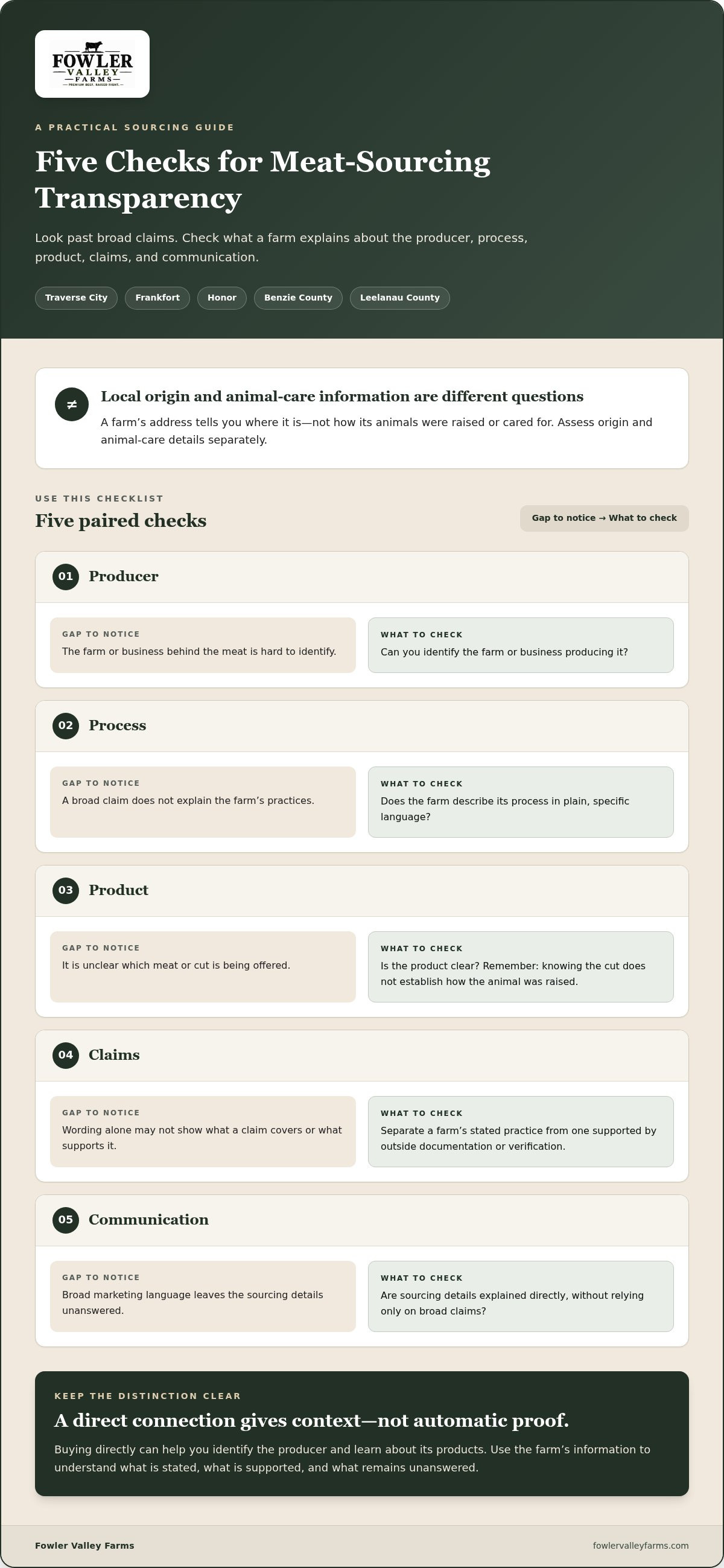
A farm’s address tells you where it is, not how its animals were raised or what practices it follows. Local origin and independently verified animal-care practices are different kinds of information, so assess them separately. When comparing a Traverse City ethical meat source, use the farm’s descriptions as a starting point, then look closely at what each claim says and supports.
Use this checklist to assess how clearly a farm explains its sourcing:
- Producer: Can you identify the farm or business behind the meat?
- Process: Does the farm describe its practices in plain, specific language?
- Product: Is it clear which meat or cuts are being offered?
- Claims: Does the farm distinguish a stated practice from one supported by outside documentation or verification?
- Communication: Are sourcing details explained directly, without relying only on broad marketing language?
What can a farm explain clearly about its meat?
Look for a straightforward account of who produces the meat and how the farm describes its process. Product details matter, too. Knowing whether you’re choosing beef, pork, chicken, or a particular cut helps you understand what you’re buying. It doesn’t, by itself, establish how the animal was raised.
Be precise about what a statement tells you. A farm’s own description explains what it says it does. Independent verification is a different form of evidence. For background on one federal animal-welfare law, the USDA provides an overview of Animal Welfare Act standards. Don’t assume that one law or a product label answers every question about food-animal care. Consider what a specific claim covers and what evidence supports it.
How do local farm relationships support informed choices?
Buying directly from a farm gives you a clear path to information about that farm and its products. You can identify the producer rather than relying on a broad claim separated from its source. That relationship offers context, not automatic proof of a particular practice.
We’re the Putt family, and Fowler Valley Farms is family-owned and operated across multiple generations. We sell processed beef, pork, and chicken directly to households. To learn more about our family and farm, read about Fowler Valley Farms. From Traverse City and Leelanau County to Honor, Frankfort, and Benzie County, keep the same steady approach: identify the producer, read the product details, and distinguish what’s clearly described from what’s independently verified.
Local Farm Meat Versus Broad Ethical Labels: What Should You Compare?
A farm’s location, a broad label, and a direct buying relationship each tell you something different. None alone gives you a complete picture of how meat was produced. If you’re comparing options for a Traverse City ethical meat source, look at the detail behind each claim and the kind of relationship you’ll have with the seller.
| What to compare | Local seller | Direct-to-consumer farm | Broad marketplace |
|---|---|---|---|
| Sourcing detail | May share where products are sold or sourced. Check what the seller states specifically. | Can explain its own farm and products directly. | May bring together independent producers. Details can vary by listing. |
| Product choice | Depends on the seller’s offerings. | May offer cuts, boxes, or other formats from the farm. | Choice may span products from multiple producers. |
| Buying relationship | You buy from a nearby retailer or seller. | You buy from the farm producing and selling the meat. | You use a platform to find or purchase from producers. |
Do ethical labels tell the whole story?
Think of a label as a starting point. It may identify a claim, but it doesn’t necessarily explain the farm’s full process or establish every practice a shopper cares about. Read the wording closely, then look for a plain description of what the claim means and who stands behind it. Don’t fill in gaps with assumptions.
Some programs offer a more specific point of reference. For example, Michigan State University Extension describes the Beef Quality Assurance (BQA) program in the context of animal care and food safety. A named program can help you understand what a producer is referring to, but it shouldn’t be treated as a universal guarantee about every ethical concern. Weigh each claim by its stated scope and supporting information.
What does buying direct change for Northern Michigan households?
Buying directly from a farm gives you a more direct route to information about that farm’s products. A local shop may sell meat from different sources, while a marketplace can connect shoppers with multiple producers. Those models can all be useful, but a seller’s location or a platform alone doesn’t establish a product’s origin or animal-care practices.
We’re a family-owned, multigenerational farm selling beef, pork, and chicken directly to households. Our customers can choose individual cuts, beef boxes, a Build Your Own Beef Box, or subscriptions. That gives households in Traverse City and across Northern Michigan a direct way to buy from Fowler Valley Farms and learn about the farm behind their order. Compare sourcing details, product choice, and the buying relationship, then decide which fit your household and priorities.
How to Buy Farm Meat Around Traverse City and Northern Michigan
Once you’ve found a farm whose sourcing details you understand, choose a buying format that fits the way your household cooks and shops. For shoppers in Traverse City, Frankfort, Honor, Benzie County, and Leelanau County, these steps can help you plan an order without guessing about products or delivery arrangements.
- Decide what you want to cook. Start with the kinds of meals your household makes and whether you’re looking for beef, pork, chicken, or a mix.
- Choose how much selection you want. Individual cuts let you choose pieces one at a time. A curated beef box offers a grouped selection, while a Build Your Own Beef Box lets you select the beef cuts for your box.
- Pick an ordering format. If you prefer recurring beef orders, a subscription is another option. Consider how often you cook at home and whether you want to choose each order yourself or use a recurring format.
- Review local delivery information. Before planning around delivery, read the farm’s ordering and delivery details so you understand the process and can make an informed choice.
Which buying format fits your household?
If you’re trying a particular cut or planning a specific meal, individual cuts offer a direct way to choose. A curated beef box can suit households that want a selection together, while the Build Your Own Beef Box gives you more say in the cuts included. Subscriptions suit shoppers who want beef orders to recur rather than choosing a new format each time.
There isn’t one right choice. Think about freezer space, the meals you make, and how much you want to decide up front. For example, a Traverse City household might choose individual cuts for a planned dinner, while a family in Honor may prefer a box for several meals. Those are shopping preferences, not assumptions about what any household needs.
How can shoppers make local ordering straightforward?
Keep the practical details close at hand. Review product information, select a format, and read the farm’s local delivery guidance before placing an order. Shoppers in Frankfort, Benzie County, or Leelanau County should use the published delivery information to understand the process rather than infer coverage from a map or the word “local.”
We offer individual cuts, beef boxes, a Build Your Own Beef Box, subscriptions, and local delivery. For ordering and delivery details, read our local beef delivery FAQ. It’s a practical next step as you choose the farm meat and ordering format that fit your household.
Choose Fowler Valley Farms as Your Traverse City Ethical Meat Source
Choosing a meat source comes down to understanding who produces your food and finding a way to buy that works for your household. We’re the Putt family, and Fowler Valley Farms is a family-owned, multigenerational, direct-to-consumer farm. We offer several ways to choose meat for your table.
That direct connection gives you a clear place to begin learning about the farm and its products. As you consider a Traverse City ethical meat source, look for specific information about sourcing and practices, then match what you learn to the values that matter to your family. A farm’s history and buying options are useful context, not a substitute for details about particular animal-care practices.
What can you order from Fowler Valley Farms?
You can choose processed beef, pork, and chicken in formats suited to different shopping preferences. Individual cuts work well when you have a particular meal in mind. Curated beef boxes group beef products together, while the Build Your Own Beef Box lets you select beef products for your box. Beef subscriptions offer a recurring way to order.
Take a look at our beef box options to explore the box format, or choose individual cuts if you’d rather decide one piece at a time. Think about what your household cooks, how much selection you want, and whether you prefer to choose each order or set up recurring beef orders.
What is a practical next step for local shoppers?
Start with the product format that feels manageable. You might choose individual cuts for meals you already make, a curated box for a range of beef products, or a custom-built box when you want to select the beef yourself. If recurring orders suit your routine, a subscription gives you another format to consider.
For households in Traverse City and across Northern Michigan, buying direct means choosing products from a family-run farm rather than relying on a broad label alone. We offer beef, pork, and chicken, with individual cuts, beef boxes, subscriptions, and local delivery. Choose the format that fits your table, then build a beef box with the cuts your household wants.
Build a beef box with the cuts your household wants.
Make Your Next Meat Purchase With Confidence
A thoughtful choice starts with clear sourcing details, not a broad label or a farm’s location alone. Look for plain explanations of who produces the meat and what specific practices are described. Then choose a way to buy that suits your household, whether that means individual cuts, a beef box, or recurring orders.
For shoppers seeking a Traverse City ethical meat source, Fowler Valley Farms offers a direct relationship with a family-owned farm operated by the Putt family across multiple generations. We offer beef, pork, and chicken, with individual cuts, beef boxes, subscriptions, and local delivery. That gives households around Traverse City, Frankfort, Honor, Benzie County, and Leelanau County different ways to shop for farm-raised meat.
Start with the format that works for your meals and your table. If you’d like to choose the beef cuts that go into your box, build a beef box with the cuts your household wants. Choose the cuts that fit your household and place your order with Fowler Valley Farms.
Frequently Asked Questions
What does ethical meat sourcing mean?
Ethical meat sourcing means understanding where meat comes from and what information the producer shares about its practices. There isn’t one definition that fits every shopper or farm. Look for specific explanations rather than relying on a broad label alone. If a detail matters to your household, distinguish what the producer states from what can be independently verified. That helps you make a choice based on your own priorities.
How can I find an ethical meat source near Traverse City?
Start by reviewing how farms and meat sellers serving Traverse City and Northern Michigan describe their products and sourcing. Consider whether you can buy directly from the farm and whether its ordering options suit your household. Fowler Valley Farms is a family-owned, multigenerational farm selling beef, pork, and chicken directly to consumers. Individual cuts, beef boxes, subscriptions, and local delivery offer different ways to shop.
How do I choose between individual cuts and a beef box?
Individual cuts work well if you know which items you want to choose. A curated beef box groups products together, while a Build Your Own Beef Box lets you select beef products for your order. Think about the meals your household cooks and how much choice you want. Then explore the available options and choose a format that feels practical for your home.