Article: How to Cook Ribeye Steak at Home (Better Than Most Restaurants)
How to Cook Ribeye Steak at Home (Better Than Most Restaurants)
We get asked this at the farmers' market more than almost anything else.
Someone picks up a ribeye from our cooler at the Frankfort booth on a Saturday morning, holds it up, and says — "Okay, but how do I actually cook this thing so I don't ruin it?"
It's a fair question. A good ribeye deserves a good cook. And honestly, once you know a few simple things, cooking ribeye steak at home is easier than most people think — and better than most restaurants, because you're starting with better beef.
Here's exactly how we do it.
What You'll Need
- 1 ribeye steak, at least 1 inch thick (ideally 1.25–1.5 inches)
- Kosher salt — generous
- Freshly cracked black pepper
- 1–2 tablespoons of beef tallow, avocado oil, or clarified butter
- 2 tablespoons unsalted butter
- 3–4 garlic cloves, smashed
- A few sprigs of fresh thyme or rosemary (optional but worth it)
- A cast iron skillet — this is non-negotiable
That's it. The ribeye does the work. Your job is to stay out of its way and add a little heat and butter at the right moments.
Before You Even Touch the Pan
Take your steak out of the fridge 30–45 minutes before you cook it.
We know — this feels like it shouldn't matter. It does. A cold steak hitting a hot pan cooks unevenly. The outside overcooks before the center reaches temperature. Room temperature beef sears faster and more evenly, and you get that crust without the grey band underneath.
Season aggressively with kosher salt — on both sides and the edges.
More than you think. Ribeye has the fat and the thickness to handle it. Season at least 30 minutes before cooking, or right before it hits the pan. If you salt and let it sit for 10–15 minutes, you'll see moisture bead up on the surface — just pat it dry with a paper towel before it goes in the pan. Dry surface = better crust.
How to Cook Ribeye Steak at Home: The Method
Step 1 — Get your cast iron screaming hot
Set your cast iron skillet over high heat for 3–4 minutes. It should be hot enough that a drop of water evaporates immediately on contact. Add your fat of choice (tallow is our pick — we render it ourselves from our beef, and the flavor it adds to a sear is unreal). Let it heat until it just begins to smoke.
Step 2 — Sear the first side — don't touch it
Lay the ribeye away from you into the pan. It should sear immediately and loudly. Press it gently into the pan for the first 10 seconds to ensure the entire surface makes contact.
Leave it alone for 2–3 minutes.
No moving, no pressing, no peeking. The crust forms from sustained contact with heat. Every time you move it, you interrupt that process. Set a timer and walk away.
Step 3 — Flip once, add butter and aromatics
Flip the steak. It should release cleanly — if it sticks, it's not ready. Give it another 30 seconds.
Once flipped, add the butter, smashed garlic cloves, and herbs directly to the pan. As the butter melts and foams, tilt the pan slightly and use a large spoon to baste the steak continuously with the butter — spooning it over the top of the steak in a constant rhythm. Do this for 1–2 minutes.
This step is what separates a good home ribeye from a great one. The butter basting coats the steak's surface with fat and infuses the garlic and herb flavor into the crust. It's the reason great steakhouses taste the way they do.
Step 4 — Check temperature, not time
Every steak is different — thickness, starting temperature, and your stove's heat output all vary. Use a meat thermometer. Not a guess. Not a finger poke. A thermometer.
Temperature guide:
- Rare: 120–125°F (deep red center, very soft)
- Medium-rare: 130–135°F — this is where ribeye shines
- Medium: 140–145°F (slightly pink center, firmer)
- Medium-well: 150–155°F (just a trace of pink)
- Well done: 160°F+ (please don't do this to a ribeye)
Pull the steak 5°F below your target — it will continue to rise as it rests.
Step 5 — Rest. This is not optional.
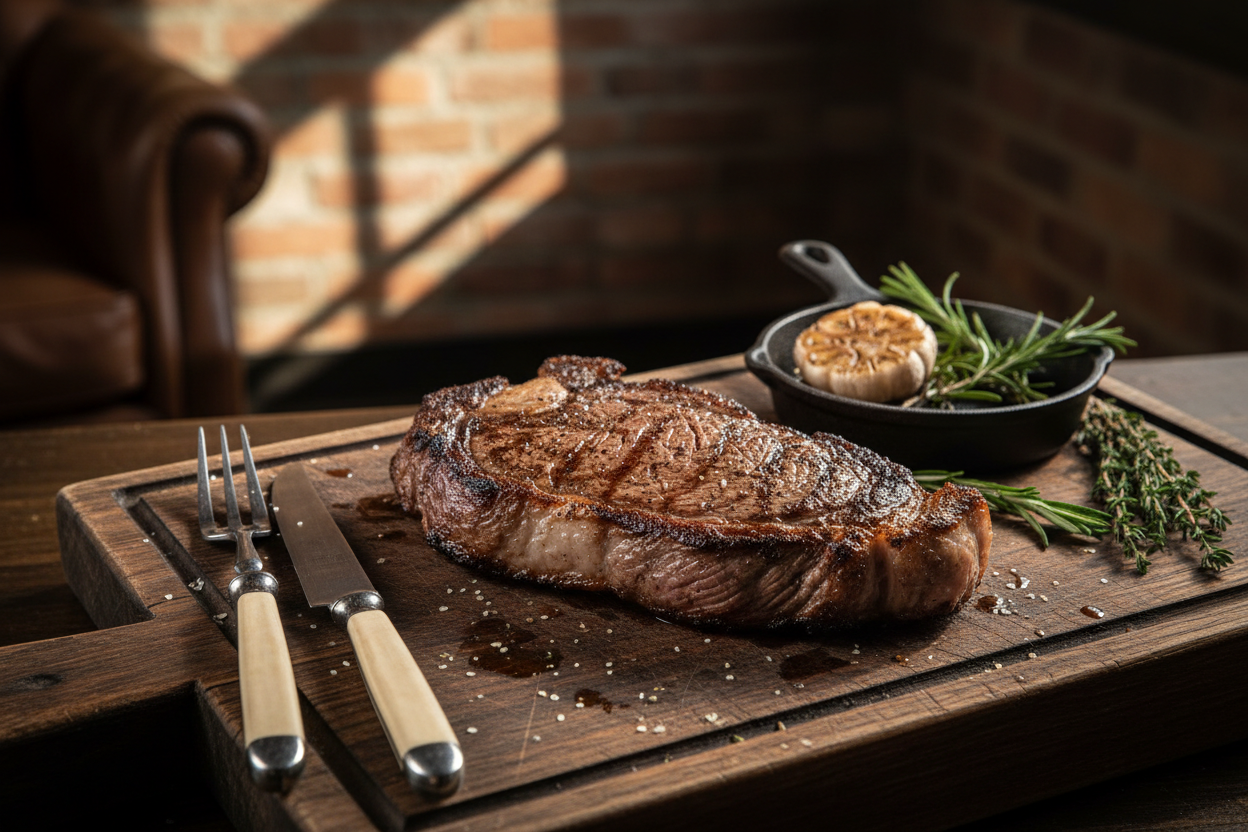
Transfer the ribeye to a cutting board or warm plate and let it rest for 5–8 minutes, uncovered.
This is the step most people skip and the reason most home steaks are disappointing. Resting allows the muscle fibers — which tighten under heat — to relax and reabsorb the juices that have been pushed toward the center. Cut it too soon and those juices pour out onto your cutting board instead of staying in your steak.
5 minutes of patience = a noticeably juicier steak.
Step 6 — Slice against the grain and finish with a pinch of flaky salt
Ribeye is naturally tender, so slicing against the grain is less critical than with tougher cuts — but it still matters. Look for the direction the muscle fibers run and cut perpendicular to them.
Finish with a small pinch of flaky salt (Maldon or similar) right before eating. Not before — flaky salt dissolves. Right before. It adds a small crunch and a final hit of seasoning that pulls the whole thing together.
A Note on the Beef
We've noticed over the years that the number one thing that separates a memorable steak from a forgettable one isn't the technique — it's what you start with.
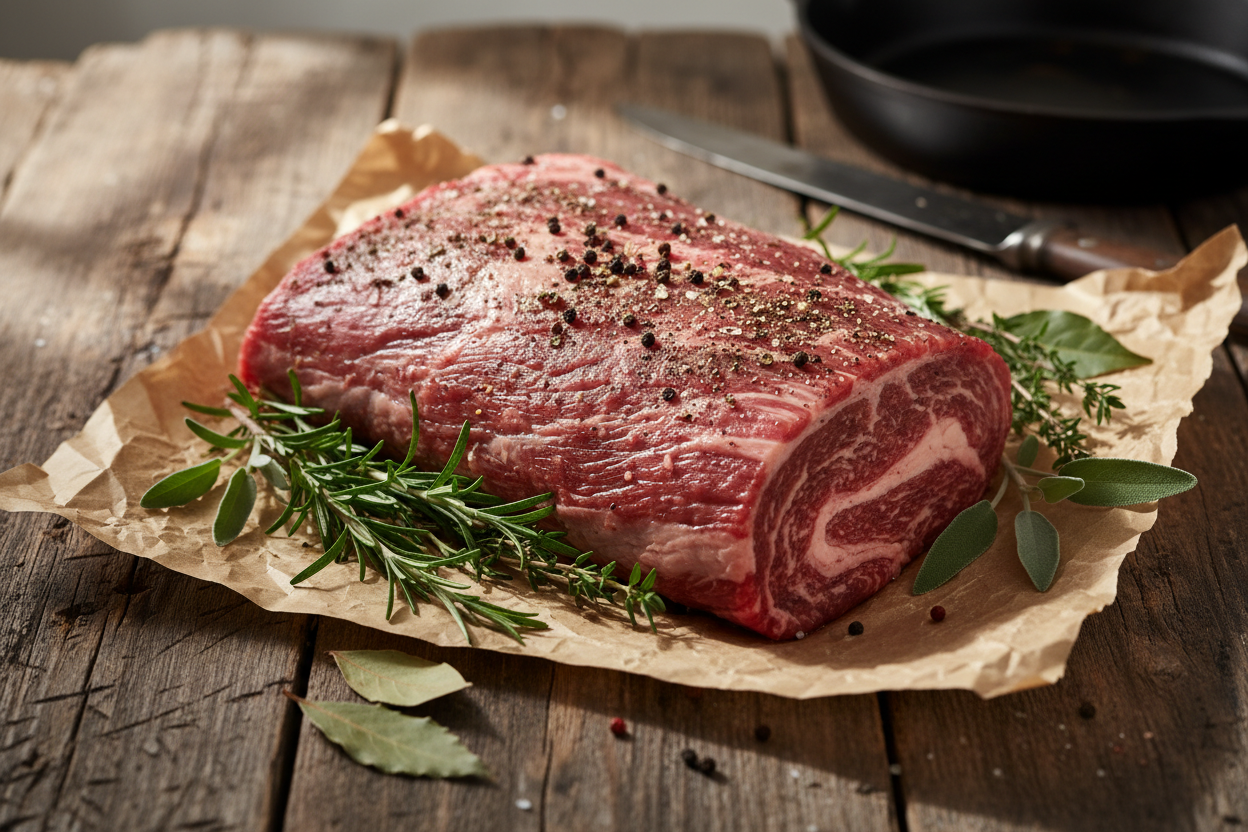
Our ribeyes come from cattle raised on open Northern Michigan pastures and finished on grain for the marbling that makes a ribeye a ribeye. No added hormones, no antibiotics, no shortcuts. When you cut into one of our ribeyes, you'll see the fat running through the muscle in thin white lines — that's the marbling that bastes the steak from the inside as it cooks.
Grocery store ribeyes can be great. But if you've ever tasted the difference between commodity beef and beef from a farm you can name, you already know why it matters.
Quick Reference — How to Cook Ribeye at Home
| Step | What to do |
|---|---|
| Prep | Bring to room temp 30–45 min before cooking |
| Season | Kosher salt + pepper, both sides + edges |
| Pan | Cast iron, screaming hot, lightly smoked fat |
| Sear side 1 | 2–3 minutes, don't touch |
| Sear side 2 | Flip, add butter + garlic + herbs, baste 1–2 min |
| Pull temp | 5°F below target (medium-rare = pull at 130°F) |
| Rest | 5–8 minutes uncovered on cutting board |
| Finish | Flaky salt right before eating |
Frequently Asked Questions
Can I cook ribeye in a regular pan instead of a cast-iron pan? You can, but cast iron holds heat better than almost any other pan, which is what creates the crust. A stainless steel pan works as a second choice. Non-stick pans don't get hot enough — skip them for steak.
Should I use butter or oil to start the sear? Start with a high smoke-point fat (tallow, avocado oil, or grapeseed oil) for the sear — butter burns at high heat. Add the butter in the last 1–2 minutes of basting, once the heat is slightly lower.
How thick should a ribeye be for cooking at home? At least 1 inch. 1.25–1.5 inches is ideal. Anything thinner overcooks too fast to develop a crust. Anything over 2 inches is better reverse-seared (low oven first, then sear at the end).
What's the best way to store leftover cooked ribeye? Slice it, store in an airtight container in the fridge for up to 3 days. Reheat gently in a pan over low heat with a small amount of butter — do not microwave. Cold leftover ribeye sliced thin is also excellent in a steak sandwich the next day.
Our ribeyes are available in our Farmhouse Favorites Box, Homestead Family Box, and Rancher's Choice Box — or as individual cuts in our online store. We ship nationwide with free shipping on orders over $150, and we deliver locally across Northern Michigan, including Traverse City, Frankfort, Benzie County, and Leelanau County.
— The Putt family, Fowler Valley Farms, Honor, Michigan