How to Butterfly a Whole Chicken: A Clear, Step-by-Step Guide
Learning how to butterfly a whole chicken starts with one careful cut along the backbone. Remove that bone, press the bird flat, and it will sit more evenly in the pan or on the grill. If you’re unsure where to cut or how to keep the chicken steady, the shears can feel awkward at first.
You don’t need fancy tools or guesswork. We’ll show you how to use kitchen shears, flatten the bird, and handle raw chicken safely from prep through cleanup. Here in Northern Michigan, from Traverse City to Frankfort and Leelanau County, a steady method makes this kitchen job easier. At Fowler & Valley Farms, we’re glad to share practical ways to prepare chicken for the table.
Follow each cut, check that the chicken lies level, and use a food thermometer to confirm doneness. USDA guidance calls for poultry to reach 165°F in the thickest part, away from the bone. Then you can roast or grill your butterflied chicken with more confidence.
Key Takeaways
- Find the backbone and cut it out steadily with kitchen shears.
- Turn the bird breast-side up and press over the breastbone to help it lie flatter.
- Season over the skin and beneath it where you can reach.
- Use a food thermometer to check doneness, then let the chicken rest before carving.
- Handle leftovers promptly and store them safely for another meal.
How to Butterfly a Whole Chicken: The Basic Method
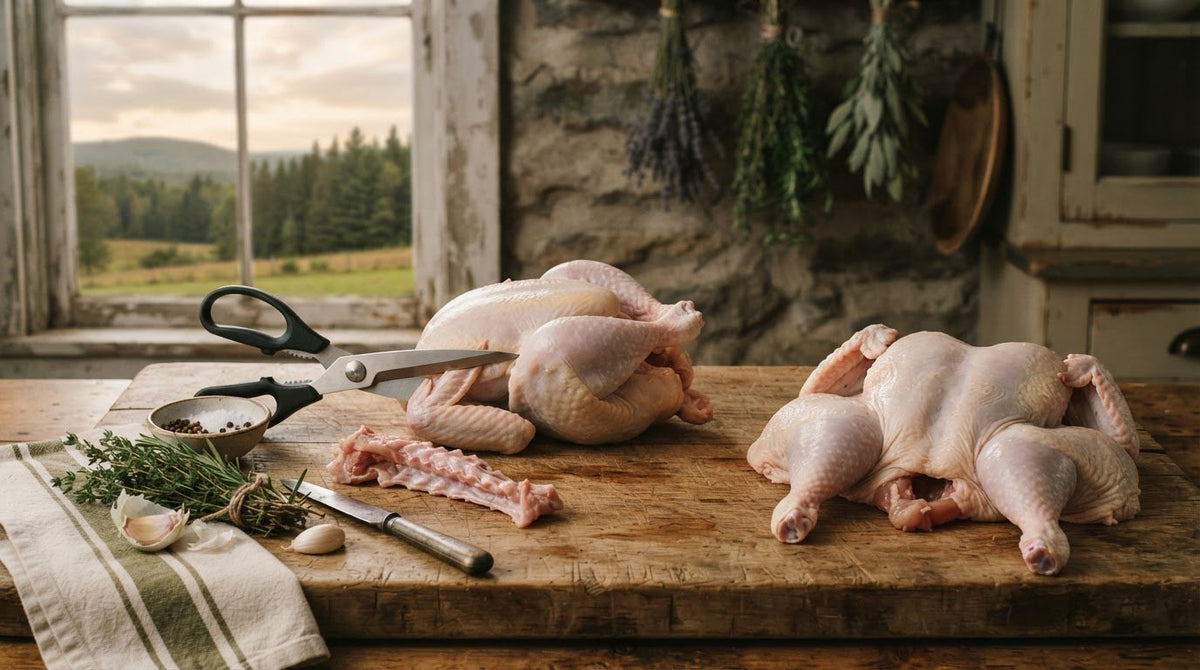
Set the chicken breast-side down on a steady cutting board. Cut along both sides of the backbone with kitchen shears, remove it, then turn the bird over and press over the breastbone. Keep your cuts controlled, and don’t force the shears or press hard enough to tear the skin.
What Does It Mean to Butterfly a Whole Chicken?
To butterfly a whole chicken, remove the backbone and press the bird flat. This technique is also called spatchcocking. The steps are straightforward with a stable work surface and the right tools. A level bird is easier to season, move, and check than one that shifts around in the pan.
Removing the backbone changes the chicken’s shape. Instead of sitting upright, it opens out with the breast and legs closer to the same level. That broader shape can help the parts cook more evenly, though the result still depends on the bird and cooking method. The open cavity also makes it easier to season the meat and check different areas with a thermometer. For background on the name, see What is Spatchcocking?
Why flatten a chicken before cooking?
A whole chicken has thick and thin areas, and its rounded shape can leave parts at different distances from the heat. Flattening spreads the bird into a more even layer, which may help the breast and legs cook at a similar pace. It doesn’t guarantee a particular cooking time, so use a thermometer rather than relying on appearance alone.
The open shape is practical at the counter, too. You can spread seasoning over more of the skin and reach beneath it where accessible. During cooking, the breast and legs are easier to see and reach when checking doneness.
What tools do you need to butterfly a chicken?
Gather sturdy kitchen shears, a stable cutting board, and paper towels before you start. Set the board on a firm, level counter. If it shifts, place a clean, damp kitchen towel underneath to hold it steady.
- Kitchen shears: Choose a sturdy pair that opens comfortably and can cut through joints and small bones.
- Cutting board: Use one large enough to support the whole chicken without crowding your work area.
- Paper towels: Keep a few within reach to dry your hands or the board, then discard any that touch raw chicken.
- Chef’s knife: A sharp knife can help remove a small bone fragment the shears leave behind. Use it carefully for that trimming, not as a substitute for shears along the backbone.
Before you begin, clear away other ingredients and utensils so raw-poultry tools stay separate. Don’t rinse the chicken; splashing can spread raw juices around the sink and counter. After handling it, wash your hands, tools, and work surfaces with hot, soapy water. Keep your grip secure and let the shears do the cutting.
How to Remove the Backbone from a Whole Chicken
Work slowly and keep the chicken steady. The backbone is the long central bone running along the bird’s back, from the neck end to the tail. You’ll cut down both sides, leaving the breast intact. Short, controlled cuts are easier to manage than forcing the shears through a resistant spot.
Where exactly should you cut?
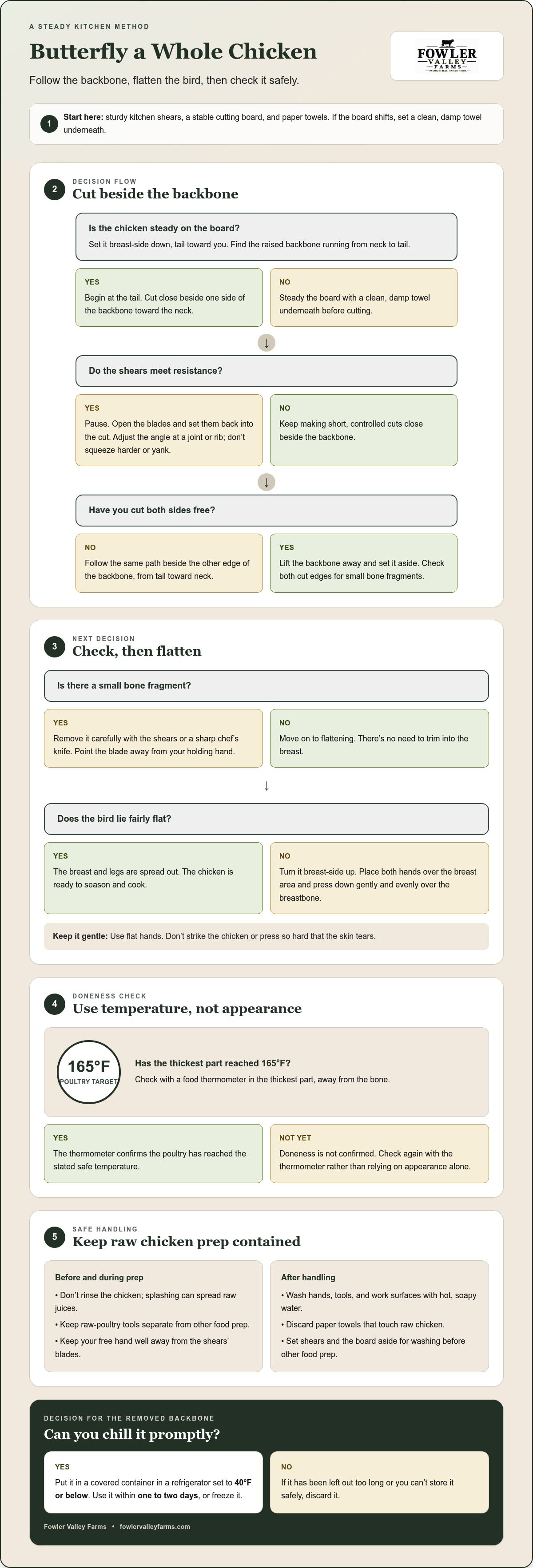
Set the chicken breast-side down, with the tail end facing you. Find the raised line of bone down the center of its back. Start just beside that line at the tail and cut toward the neck, keeping the shears close to the backbone. You’re cutting through the ribs alongside it, not across the breastbone.
- Position the chicken. Place it breast-side down on the stable cutting board, with the neck end pointing away from you.
- Locate the backbone. Feel for the long, firm ridge running down the center from neck to tail.
- Make the first cut. Starting at the tail, cut close beside one side of the backbone toward the neck.
- Reposition the shears as needed. If a rib or joint resists, pause, open the blades, and set them back into the cut instead of squeezing harder.
- Cut the opposite side. Follow the same path beside the other edge of the backbone, from tail toward neck.
- Lift away the backbone. Once both sides are cut free, raise the bone from the board and set it aside.
How to finish removing the backbone safely
Before each snip, steady the chicken with your free hand well away from the blades. Keep your fingertips out of the shears’ path, and turn or reposition the bird if you can’t reach a section comfortably. If a joint holds the backbone in place, adjust the angle and make another careful cut. Don’t yank sharply, since pulling can make the bird slide.
Check both cut edges once the backbone is out. If you find a small bone fragment, remove it carefully with the shears or a sharp chef’s knife, keeping the blade pointed away from your holding hand. There’s no need to trim into the breast. A neat cut beside the backbone is enough.
You can save the backbone for stock if you can chill it promptly. Put it in a covered container in a refrigerator set to 40°F or below, and use it within one to two days; otherwise, freeze it. If it has been left out too long or you can’t store it safely, discard it. Set your shears and board aside for washing before moving on to other food prep.
How to Flatten a Butterflied Chicken and Fix Common Problems
With the backbone removed, turn the chicken breast-side up. The legs and breasts should spread out, but the bird may still arch in the middle. That’s common. The goal is a flatter, more level shape, not a perfectly pressed sheet of meat.
How do you get the chicken to lie flat?
Place both hands over the breast area and press down with steady, even pressure. You’re pressing over the breastbone to help the bird open. Keep your hands flat and use gentle pressure; don’t strike the chicken or press so hard that the skin tears.
Ease off, then look at the bird from the side. The breast and legs should be spread out, with no major raised section lifting the center. Check that the left and right sides sit at a similar height on the board. If one side still arches, reposition the bird so it rests evenly, then press again over the breastbone.
What if a bone or joint resists?
Stop pressing if the bird won’t open or you feel a firm point holding it up. Check the back edge first: a strip of backbone may still be attached. Use kitchen shears to carefully trim the remaining bone free while keeping the chicken stable.
If the backbone is clear, the resistance may be around a joint. Don’t twist a leg or force the joint flat. Reposition the bird and try gentle, even pressure over the breastbone again. A joint can keep its natural curve, so aim for a level bird rather than forcing every part into a straight line.
If a small section of bone still prevents the chicken from opening, inspect the cut edges and trim only what remains attached to the backbone. Use short, controlled snips. If you can’t see what’s resisting, pause and adjust the bird on the board instead of cutting blindly.
Once it lies evenly, the chicken is ready for seasoning and cooking. Butterflying is about making a clean opening and a stable shape, not pressing as hard as you can. Chicken is one of the meats we offer for home-cooked meals. Find chicken from Fowler Valley Farms for your next one.
How to Season and Roast a Butterflied Whole Chicken Safely
Butterflying prepares the chicken for cooking; it doesn’t set a roasting time or oven temperature. Those depend on the bird and the recipe you’re following. Season the flattened chicken as you like, cook it according to your chosen method, then use a food thermometer, not skin color or a timer alone, to check that it’s cooked safely.
How should you season a butterflied chicken?
Salt, pepper, and herbs make a simple starting point, but they’re options, not a requirement. The open shape exposes more skin, so you can season across the breast, legs, and wings instead of reaching around a rounded bird. If the skin lifts easily, work seasoning beneath it in accessible spots. Keep raw chicken on its own board, wash your hands after touching it, and don’t rinse the bird.
Use a clean plate or tray to carry the seasoned chicken to the cooking area. Keep raw-chicken juices away from ready-to-eat foods, and wash any utensils or surfaces that touched the raw bird with hot, soapy water. These habits help keep preparation orderly from counter to oven or grill.
How can you tell when the chicken is cooked?
Use an instant-read food thermometer to check the thickest part of the breast and thigh, without touching bone. Bone can affect the reading, so reposition the probe if it meets resistance. Check more than one area; the breast and thigh may not finish at the same moment. If a spot is below the safe temperature, continue cooking and check again.
USDA guidance sets 165°F (74°C) as the safe minimum internal temperature for all poultry, measured in the thickest part of the meat with a food thermometer, away from bone. That’s the reliable doneness check for a whole butterflied chicken. Color, clear juices, and crisp-looking skin can’t confirm the internal temperature on their own.
Once the thermometer confirms the chicken has reached 165°F in the areas you checked, follow your recipe’s serving instructions. Take care handling the hot pan or grill, and use clean utensils and a clean platter for the cooked bird. For another home-cooked meal, choose chicken from Fowler Valley Farms.
Serve the Chicken, Store Leftovers, and Choose Your Next Bird
Once the chicken is cooked, let it rest before carving. USDA guidance recommends resting poultry for 5 to 10 minutes after cooking. Set it on a clean platter, then use a clean knife and fork to slice the breast and separate the legs and thighs at their joints. Keep raw-poultry tools away from the cooked chicken.
How should you rest, carve, and store the chicken?
Start with the breast. Cut down the center of the breastbone, then slice the breast meat from each side in manageable pieces. To separate a leg and thigh, pull the leg gently away from the body and cut through the joint where it meets the carcass. If the joint resists, adjust the angle rather than forcing the knife.
Serve what you plan to eat, then put leftovers away promptly. USDA guidance recommends refrigerating cooked chicken within two hours and using it within three to four days. Store it covered in the refrigerator, and use clean hands and utensils when packing or serving it. Separating the meat from the bones can make portions easier to use for another meal.
How does the method fit a Northern Michigan kitchen?
Butterflying gives you a practical way to prepare one bird for a family meal, whether you’re cooking in Traverse City, Frankfort, Leelanau County, Kalkaska, or Boyne City. The same simple method works in kitchens around Grand Rapids, Bay City, Midland, Saginaw, Freeland, Clare, Cadillac, Kingsley, Detroit, Chicago, Grand Haven, and Muskegon. The opened shape is straightforward to season, cook, and carve, and leftover pieces can be set aside for another meal. Take your time and use clean equipment.
At Fowler Valley Farms, we’re a family farm offering chicken alongside beef and pork. For your next home-cooked meal, explore our chicken and meat offerings and choose what suits your table.
Bring a Whole Chicken to Your Next Family Meal
Let your next meal be a chance to make this technique your own. Once the steps feel familiar, preparing a whole chicken can become a steady part of your home cooking, whether you’re planning a quiet dinner or setting the table for family. There’s no need to rush. Take care with each cut, and let practice build confidence.
We’re the Putt family, and our family has operated Fowler Valley Farms across multiple generations. Chicken is among the meats we offer for home cooking, alongside beef and pork. We’re glad to put good food on Northern Michigan tables.
For your next meal, explore chicken and farm-raised meat from Fowler Valley Farms. Choose a bird, make a little room on the board, and put your new kitchen skill to use.
Frequently Asked Questions
Is spatchcocking the same as butterflying a whole chicken?
Yes. In everyday cooking, the terms are commonly used for the same preparation: removing the backbone and opening the bird so it lies flat. “Spatchcock” specifically refers to this way of preparing poultry, while “butterfly” can describe opening other foods flat as well. Recipe titles may use either term, so follow the instructions rather than relying on the label to show you exactly where to cut.
Can you butterfly a whole chicken without kitchen shears?
Yes, a sharp chef’s knife can work, though shears are often easier to control around the ribs. To butterfly a whole chicken with a knife, keep the bird steady on a nonslip board and make short, deliberate cuts along the backbone. Don’t force the blade through a resistant spot. If it slips or you’re unsure of your grip, stop and use shears instead.
Do you need to rinse a whole chicken before butterflying it?
No. Rinsing raw chicken can splash bacteria onto the sink, nearby counters, or utensils. If the surface needs drying, pat it with a paper towel and discard the towel right away. Keep the chicken away from ready-to-eat foods, then wash your hands and clean any surfaces or tools that touched raw juices with hot, soapy water before using them for other ingredients.