
Pasture Raised Chicken Sales and Delivery in Leelanau County
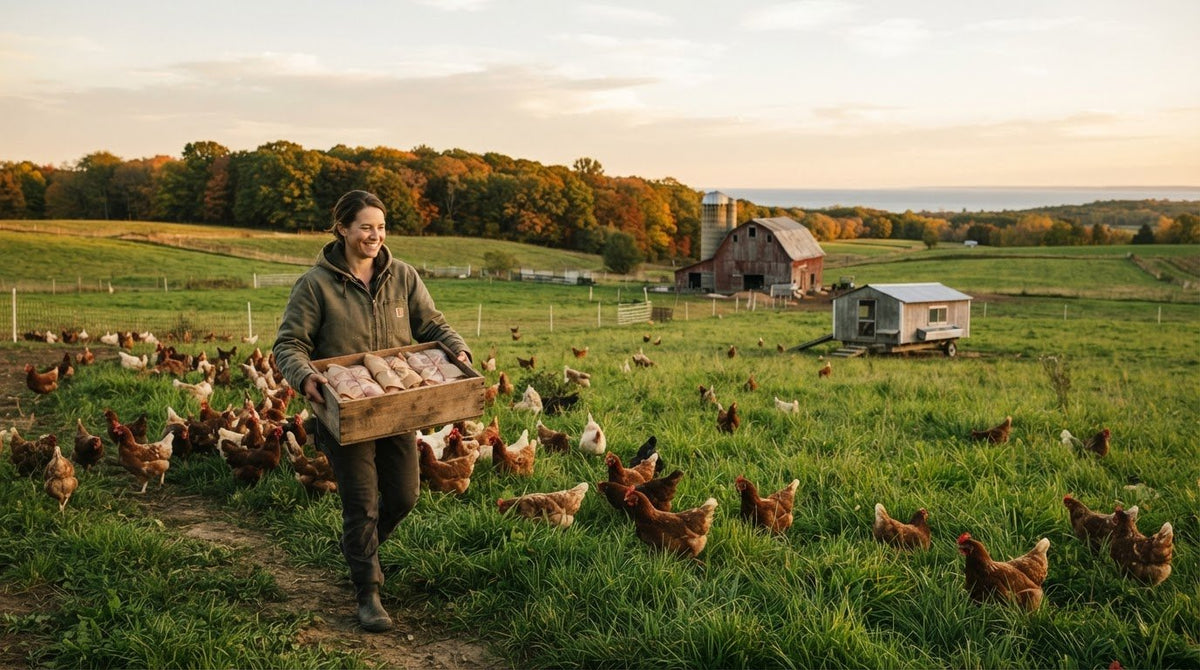
A pasture-raised label should tell you something about how a chicken lived. In Leelanau County, pasture-raised chicken comes from birds raised on a small farm, spending time outdoors with room to move and receiving daily care from the people who raise them. It’s a different approach from raising chickens in an industrial facility.
That difference matters when deciding what to bring home. Consider how the birds are raised, where local chicken is sold, and whether delivery makes buying from a farm more convenient. You may also compare flavor and nutrition with grocery-store chicken, without assuming that “farm-raised” automatically means “organic.”
Here, we’ll walk through what pasture raising looks like in Northern Michigan, how seasonal conditions shape local supply, and what to expect when buying farm-raised chicken in Leelanau County. We’ll also explain how pasture-raised chicken tends to compare with grocery store chicken in flavor and leanness, so you can make a choice that fits your table.
Key Takeaways
- Learn what outdoor access and daily care mean when chickens are raised on pasture in Leelanau County.
- Understand how Northern Michigan’s seasons shape local chicken availability and why planning purchases can matter.
- See how local farm-raised chicken differs from large-scale grocery supply, without assuming farm-raised means organic.
- Get a clearer sense of how pasture-raised chicken tends to compare in flavor and leanness.
- Explore how local sales and delivery can make farm-raised food part of your household’s regular shopping.
Local sales and delivery options
In Leelanau County, local farm-raised chicken is sold directly to families and communities. That direct route connects the household with the farm raising the birds. It also shortens the distance between farmer and customer, supporting a clearer view of how food is produced. For families in Suttons Bay, Northport, or near Traverse City, buying from a nearby farm can mean less time in transit and storage than a longer supply chain.
Prices for pasture-raised whole chickens and cuts vary by farm and by the product you choose. A whole bird and separate cuts are different purchases, so compare the listed product and amount to decide what suits your meals and freezer space.
Local farm-raised chicken can be seasonal, and quantities may be limited. Northern Michigan’s growing season and variable weather can affect when farms raise and process birds. Raising schedules and pasture conditions also shape what is available.
Buying locally usually means choosing from the farm’s current offerings rather than expecting the same selection year-round. Processing in inspected facilities is part of the local farm-raised model described for the area. The amount available can depend on the farm’s raising schedule and the season’s conditions.
Use these practical steps when planning a purchase in Leelanau County:
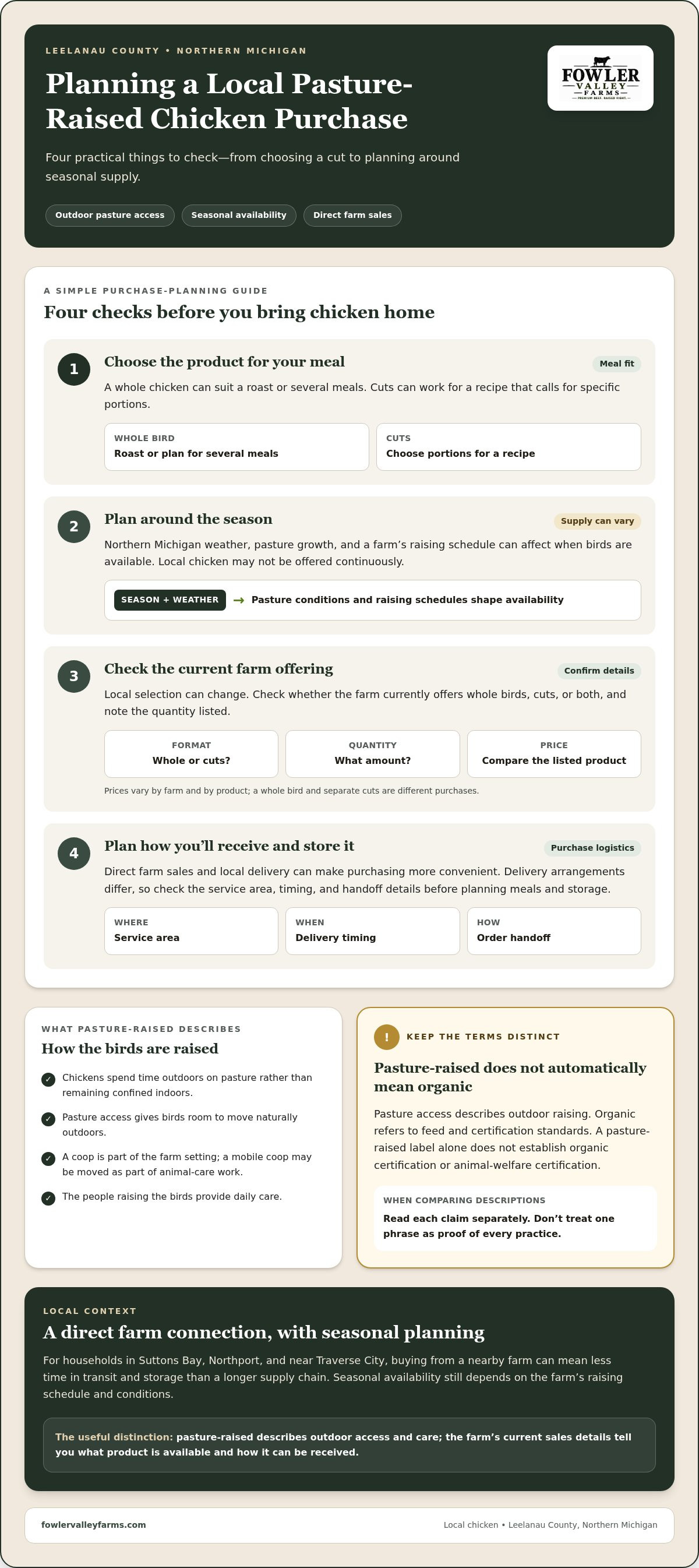
- Choose a product for your meal. A whole chicken suits a roast or several meals, while cuts can fit a recipe calling for specific portions.
- Plan around seasonal supply. Northern Michigan weather and pasture growth affect production, so local chicken may not be available continuously.
- Look at the farm’s sales details. Confirm whether the current offering is a whole bird, cuts, or both, and note the stated quantity.
- Consider how you’ll receive it. Direct farm sales and local delivery can make purchasing more convenient for households across the county.
Local delivery can also reduce the distance between the farm and your kitchen. Delivery arrangements differ, so the relevant details are the service area, delivery timing, and how orders are handed off. Those practical points help you plan meals and storage without assuming every farm uses the same process.
For Leelanau County households, local chicken offers a direct connection to the farm and a shorter route from pasture to table. Seasonal availability means planning with the growing cycle, while the product format helps determine what to bring home. The farm’s own sales information gives the clearest picture of current offerings and delivery arrangements.
Chicken housing and outdoor access
Pasture-raised chickens in Leelanau County spend time outdoors rather than remaining confined indoors. That access gives birds room to move naturally across pasture. The description concerns how chickens are raised, not simply where a product is sold. Housing and outdoor access work together: birds have a coop as part of their farm setting and time outside on pasture. At a Leelanau County farm, moving a mobile chicken coop can be one task involved in caring for the birds.
Pasture-raised does not automatically mean a farm is certified organic or animal-welfare certified. “Organic” refers to feed and certification standards; pasture access alone does not establish organic certification.
A mobile coop makes the outdoor setup easier to understand. It can be moved as part of animal-care work, so the chickens’ setting is not limited to one stationary coop location. Pasture-raised chicken in Leelanau County involves outdoor time and natural movement, alongside attention from the people who raise the birds. The particular routine can vary by farm, but those points describe the central housing distinction.
When reading a farm’s description, separate the details instead of treating one phrase as proof of every practice:
- Outdoor access: Chickens spend time outside on pasture rather than being confined indoors.
- Movement: Pasture access allows the birds to move naturally outdoors.
- Housing: A mobile chicken coop may be moved as part of the farm’s animal-care work.
- Care: The people raising the chickens provide daily attention to the birds.
Northern Michigan’s pasture has diverse grasses, and conditions change with the season and weather. That makes the outdoor setting a working part of the farm, not just a label on a package. Moving a coop is one example of hands-on care connected with chicken housing. The description does not establish a particular schedule or identical routine across farms.
For shoppers comparing pasture-raised chicken in Leelanau County, the useful distinction is specific: outdoor pasture access is different from indoor confinement. It also differs from certification claims. A pasture-raised label alone does not establish organic status, feed standards, or animal-welfare certification. Read each statement on its own, and understand what it actually describes. This keeps the terms clear when comparing how chickens are housed and cared for.
The Leelanau County farm has 2 indoor/outdoor cats. That is a separate detail about animals at the farm, rather than a description of the chickens’ housing. It does not state whether the cats enter the coop, share pasture with the chickens, or have any role in their care. Those points should not be inferred from the cats’ indoor/outdoor status. For a reader considering the chicken setup, the relevant information remains the specific account of the birds’ surroundings and the care they receive; the presence of cats does not add a claim about feed, certification, or the chickens’ routine. Keeping these details separate avoids reading more into the farm’s description than it establishes.
Chicken product description
In Leelanau County, local farm-raised chicken describes more than where a bird was sold. The term can describe a smaller-scale production setting, though practices may vary by farm. The people raising the birds provide daily care. Those details help you understand the production approach behind the food, without assuming every farm follows identical routines. A useful product description should make the distinction clear: the farm’s scale, the birds’ care, and how raising them differs from large-scale production.
Processing is another part of a product’s path. Chicken processed in an inspected facility is a statement about processing, not about the farm’s housing system or feed. Keep each claim in its proper place: “processed in an inspected facility” describes processing, while “raised on a small farm” describes the production setting.
For a practical reading, separate information into three parts: origin, care, and processing. Origin tells you whether the chicken comes from a small farm or an industrial facility. Care describes the people’s daily attention to the birds. Processing information identifies the facility setting. Together, these points give a more grounded picture than a broad phrase such as “farm chicken.” They also help you compare product descriptions without treating one phrase as proof of every other practice.
- Origin: Look for a clear description of a small farm in Leelanau County, rather than relying on a general farm-raised label.
- Care: Note whether the description explains that the people raising the chickens provide daily care.
- Processing: Check whether it identifies processing in an inspected facility as part of the product’s path.
- Meaning: Read each statement narrowly; one production detail does not establish every other practice.
These distinctions matter because product descriptions can combine several ideas. Farm origin alone does not tell you about outdoor access, and a statement about daily care does not explain processing. Consider each point separately, then together, to understand what the description actually says about the chicken.
Use the same approach when comparing local chicken with another product: identify the stated farm setting, care, and processing details. For example, a clear description may distinguish small-farm raising from industrial production and mention daily care. Those concrete details give you a useful starting point for understanding how the chicken was raised, without reading extra claims into the label.
When purchasing pasture raised chicken Leelanau County residents can place those details alongside local growing conditions without treating them as guarantees about a particular bird. In Northern Michigan, a short growing season, variable weather, and diverse pasture grasses affect food production. These regional conditions provide context for farming, but they do not establish a chicken’s feed, access to pasture, or specific care unless the product description says so. Fowler & Valley Farms is described as being neighbors with 3 wineries and a cidery. That nearby setting adds local context, while the chicken’s origin, care, and processing remain the relevant product details.
Differences from grocery store chicken
Grocery-store chicken and local pasture-raised chicken may come from different production systems. Large-scale systems are often designed for speed and uniformity, while local farms operate on a smaller scale. These differences describe scale and approach, not qualities that apply identically to every product.
“Uniformity” describes a production goal: consistent products moving through a large-scale system. A small farm operates on a different scale, with raising and care handled locally. Pasture-raised birds also spend time outdoors and can move naturally. These distinctions help explain why a local bird may differ from grocery-store chicken, without making claims about every farm or package.
Use product descriptions to compare like with like. Note whether the chicken is pasture-raised, whether its farm origin is described, and what the label says about care. A broad store label may not explain every production detail, just as a farm-raised description does not establish every possible practice.
- Production scale: Grocery-store chicken generally comes from large-scale systems focused on speed and uniformity.
- Farm setting: Local farm-raised chicken is raised on a small farm rather than in an industrial facility.
- Outdoor access: Pasture-raised birds spend time outdoors and can move naturally.
- Care: People raising local farm-raised chickens provide daily care.
Production differences can shape what you notice in the kitchen. Pasture-raised chicken tends to be leaner and more flavorful than grocery-store chicken, though that does not mean every bird tastes the same. Cooking matters, too. Compare similar cuts prepared the same way, then notice the texture and flavor.
Local and grocery-store chicken need not be opposing choices. Grocery supply relies on large-scale production, while a nearby farm offers a smaller-scale route from raising to sale. Your priorities may include production approach, convenience, or flavor. In Leelanau County, understanding these distinctions helps you choose based on the product’s stated qualities rather than assumptions.
As you compare options, ask where the chicken was raised, what the description says about its production system, and which qualities matter for your meal. A roast and a quick skillet supper may call for different cuts or sources. Next, consider the flavor and nutrition differences associated with pasture-raised chicken.
Nutrition and flavor
Consider nutrition and flavor in relation to the cut and meal you’re preparing. Breast, thigh, and whole chicken offer different amounts of meat and skin. The recipe matters, too: a roast, soup, and skillet meal each highlight chicken differently. Choose your dish first, then select a cut that suits its cooking time and texture.
For nutrition, check the specific product information instead of drawing conclusions from a raising term alone. When comparing packaged chicken, compare the same cut and the serving information shown for each. Also consider what you add at home: butter, oil, a rich sauce, or simple herb seasoning will each shape the finished meal.
You can explore flavor without complicated preparation. Start with restrained seasoning so it doesn’t overwhelm the chicken. Salt, pepper, and herbs let you notice the flavor before trying a stronger marinade or sauce another time. Take note of what your household enjoys, whether you’re roasting a whole bird or making a smaller dish.
- Choose by recipe: Match the cut to the meal, such as a whole bird for a roast or smaller portions for a weeknight dish.
- Read product details: Use the specific cut and serving information when considering nutrition.
- Keep the first preparation simple: Begin with familiar seasoning, then adjust herbs, sauces, or marinades to your taste.
- Consider the whole plate: Side dishes and added ingredients contribute to the meal as much as the chicken preparation.
There’s no single seasoning or recipe that suits every kitchen. A household that prefers gentle flavors may keep the preparation plain, while another may build a meal around a spice blend or sauce. The useful approach is to make one choice at a time: select the cut, choose the cooking method, and season to match the people at your table.
If you’re planning meals with farm-raised meat, Fowler & Valley Farms includes chicken among its available farm offerings. Use the cut and product details to guide your recipe, then let your own table tell you which preparations you’d make again.
Fowler & Valley Farms: Build Your Own Beef Box
Fowler Valley Farms offers Beef Boxes for households looking to add farm-raised beef to their routine alongside chicken. Beef Boxes provide an option for buying beef, while the Build Your Own Beef Box lets you choose a custom box. Beef subscriptions are another option for households that prefer recurring orders, and local delivery is available.
Chicken and beef serve different meals, but both can have a place in a Northern Michigan kitchen. Choose the beef option that fits how your household shops, then plan it around the chicken dishes you already make. To learn more about the available options, contact Fowler & Valley Farms or visit fowlervalleyfarms.com.
Choose What Fits Your Table
Let your meal plan guide how you shop. Consider the dishes your household cooks, the cuts that suit those meals, and the freezer space available. Choose products you can use well.
Choosing pasture-raised chicken in Leelanau County can also prompt a broader look at what you’d like to bring home. For farm-raised beef, the Build Your Own Beef Box gives you a specific option to consider alongside your meal plans.
Choose what suits your household, then explore Fowler Valley Farms’ Beef Boxes and Build Your Own Beef Box online.
Frequently Asked Questions
Where can I buy pasture-raised chicken in Leelanau County?
Fowler & Valley Farms sells chicken, and its website is a starting point for exploring the farm’s meat offerings. If you’re planning a meal, decide what you need before browsing, such as chicken for one supper or a larger grocery shop. This helps you focus on the product that fits your plans without assuming every format is available at every time.
Which Leelanau County farmers markets sell pasture-raised chicken, and when are they open?
For shoppers in Leelanau County, Suttons Bay, or Traverse City, consider the product and purchasing option that fit your meal plans. Fowler Valley Farms offers Beef Boxes, including a Build Your Own Beef Box, for customers looking to buy beef directly from the farm.
How can I contact Leelanau County farms selling pasture-raised chicken?
Use the farm’s own website to find its current contact options. Fowler & Valley Farms can be reached through its website, where you can also explore its chicken and other meat offerings. Keep your question specific, such as asking about the product you’re interested in or the available way to place an order. Clear details make it easier to get useful information for your household.
How do local farms define and verify pasture-raised chicken?
Pasture-raised describes outdoor pasture access and room for natural movement. It does not, by itself, establish organic certification or explain every detail of how birds are raised.
What is the difference between pasture-raised, free-range, and organic chicken?
Pasture-raised describes outdoor pasture access and natural movement. Organic refers to feed and certification standards, and pasture access alone does not establish organic certification. The material does not explain how free-range differs.


