Beef Marbling Scores: How They Work and Affect Flavor
A higher beef marbling score can point to more intramuscular fat, but it doesn’t tell the whole story of a steak’s flavor or tenderness. Understanding beef marbling scores means knowing which scale you’re reading: Japan’s Beef Marbling Standard runs from BMS 1 to BMS 12, with higher scores indicating more marbling, while other grading systems use different scales and criteria.
For home cooks in Northern Michigan, including Traverse City, this guide explains how beef marbling scores are assessed, what Japanese standards measure, and what a Wagyu score can suggest about flavor and tenderness.
Key Takeaways
- Learn how intramuscular marbling differs from fat between muscles, and why the distinction matters when reading a beef grade.
- Understand how Japan’s Beef Marbling Standard runs from BMS 1 to BMS 12, with higher scores indicating more marbling.
- See what marbling can suggest about flavor and tenderness, and why a score alone doesn’t tell you everything about a steak.
- Find out about free Friday delivery in Benzie, Leelanau, and Grand Traverse counties, including the Thursday order deadline.
- Explore beef boxes, Build Your Own Beef Box, and subscriptions as practical ways to choose beef for your household.
How Are Beef Marbling Scores Measured?
Marbling scores describe fat within muscle, but grading systems use different scales. Understanding beef marbling scores starts with knowing what a number measures and which system assigned it.
Marbling and Intramuscular Fat Percentages
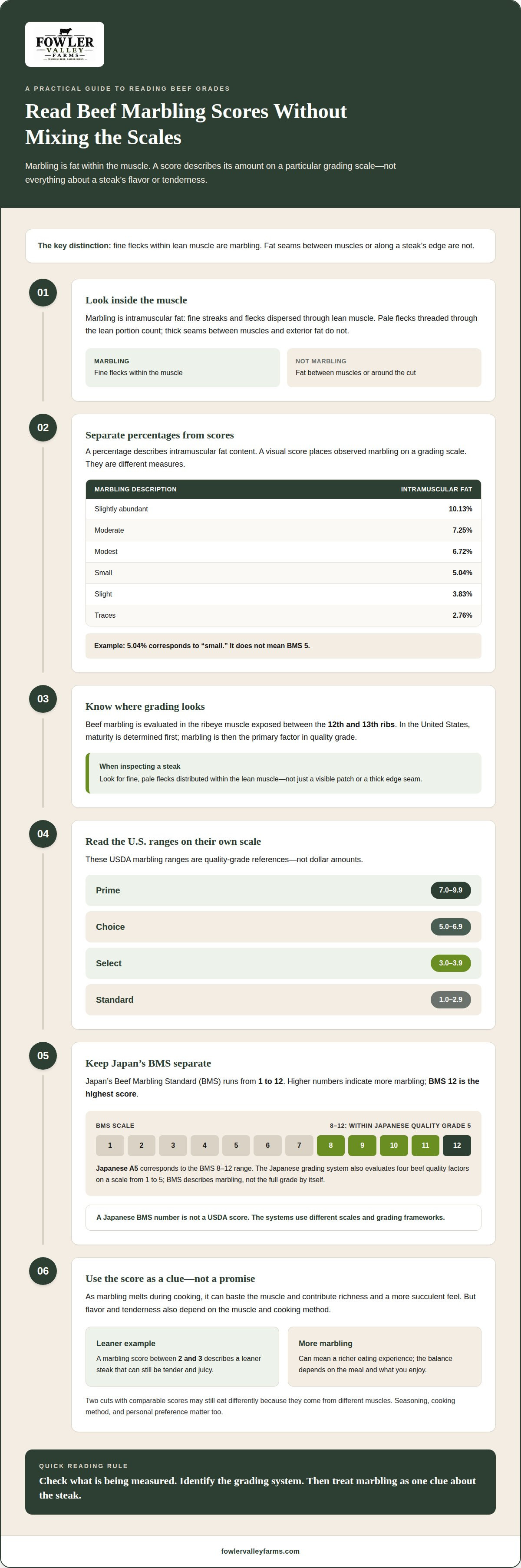
Marbling is intramuscular fat: fine streaks and flecks dispersed through lean muscle. A percentage describes how much intramuscular fat is present, while a visual score describes its amount and appearance.
Common marbling descriptions correspond to these intramuscular fat percentages:
- Slightly abundant: 10.13%.
- Moderate: 7.25%.
- Modest: 6.72%.
- Small: 5.04%.
- Slight: 3.83%.
- Traces: 2.76%.
These percentages describe intramuscular fat content, not a Beef Marbling Score. A score places observed marbling on a particular grading scale. Keeping the two measures distinct helps when a label gives a percentage but another uses a score. For example, 5.04% corresponds to the “small” description, but it does not itself mean BMS 5. Reading the figures carefully means interpreting each number within its own measure.
Distinguishing Fat Types
Intramuscular fat sits within the muscle; intermuscular fat lies between separate muscles. Only fat within the muscle forms the fine webbing called marbling.
This distinction matters when inspecting a steak. A thick seam along the edge or between muscle groups is intermuscular fat, not evidence of a high marbling score. Pale flecks threaded through the lean portion are intramuscular fat. A steak can have visible exterior fat and still show little marbling within the muscle. The score focuses on that internal pattern, not the fat around the cut.
Scoring Beef Marbling
Beef marbling is evaluated in the ribeye muscle exposed between the 12th and 13th ribs. In the United States, marbling is the primary factor determining quality grade after maturity has been determined. USDA marbling ranges include Prime at 7.0-9.9, Choice at 5.0-6.9, Select at 3.0-3.9, and Standard at 1.0-2.9.
In the United States, marbling can affect beef prices because it influences quality grade after maturity is determined. Grade is one consideration in pricing, but the score itself is not a dollar amount.
Japan’s Beef Marbling Standard, or BMS, uses a separate scale from BMS 1 to BMS 12. Higher numbers indicate more marbling, and BMS 12 is the highest score. In the Japanese grading system, BMS 8 to 12 falls within Quality Grade 5, and Japanese A5 corresponds to that range. The Japanese Meat Grading Association also evaluates four beef quality factors on a scale from 1 to 5. BMS describes marbling, not the entire grade by itself.
A Japanese BMS number is not a USDA score. The systems use different scales and grading frameworks. Understanding beef marbling scores also means identifying the grading system before comparing numbers. A high number in one system does not automatically equal the same number in another.
Spotting Marbling When Buying Beef
To identify marbling, look for fine, pale flecks or thin lines distributed within the lean muscle. The Japanese standard favors fine, evenly distributed marbling. Large exterior fat seams do not count, and one visible patch does not show how evenly fat runs through the cut.
Distinguish a printed score from the visible pattern on the steak. The score gives a grading reference; the flecks show how fat is distributed in the cut you’re viewing. For a practical look at available cuts, browse the beef selection and read each product description.
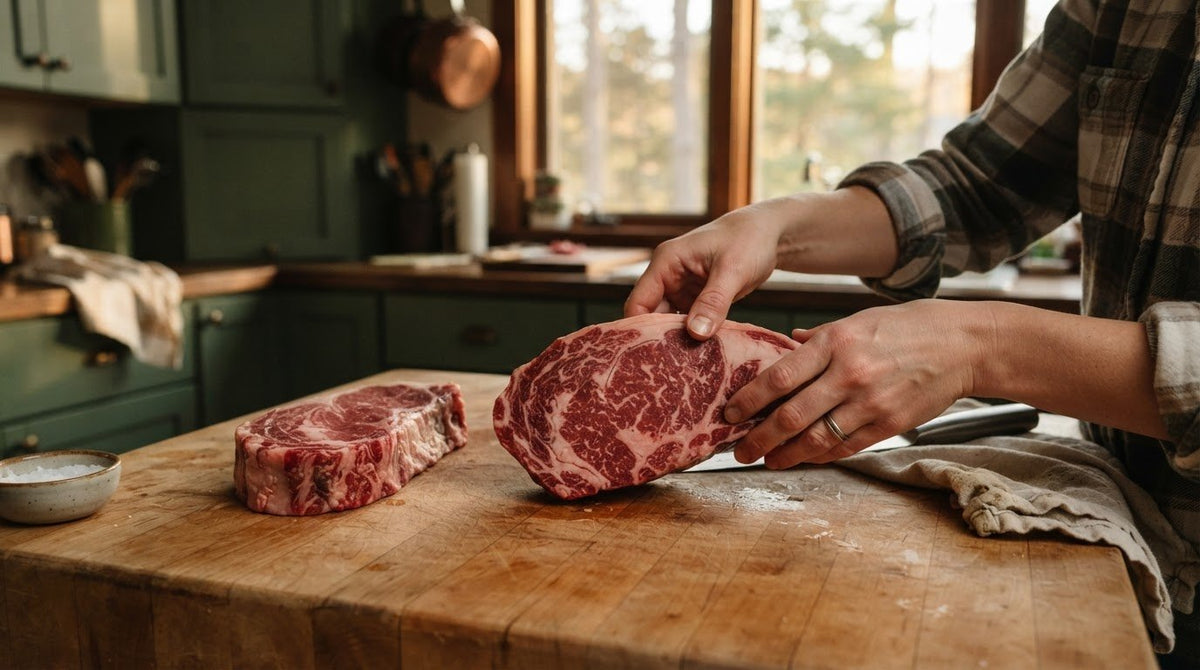
For example, assess the fine flecks within a ribeye’s muscle rather than judging only the fat around its edge. This distinction helps you understand what a marbling label describes and compare cuts more clearly.
How Does Marbling Affect Flavor and Tenderness?
Marbling affects flavor and tenderness through the way intramuscular fat responds to heat. As fat melts during cooking, it can baste the surrounding muscle and contribute to a richer taste. The effect is easiest to notice in a steak with flecks spread through the lean, where melted fat reaches more of the bite than a thick seam along the edge.
Flavor is not simply a matter of having more fat. Marbling changes the balance between beef flavor and richness. A well-marbled ribeye may taste fuller as melted fat carries savory notes across each bite. A leaner cut can offer a more direct taste of the meat, without the same buttery quality. Neither is automatically better. The right balance depends on the meal and what you enjoy eating.
Understanding beef marbling scores helps you anticipate that balance, but cannot tell you exactly how a steak will taste. A score describes marbling under a particular grading system, not the seasoning, cooking method, or preferences at your table. Two cuts with comparable scores may still eat differently because they come from different muscles. A ribeye and a leaner steak bring distinct textures and flavors, even before they reach the pan.
Marbling can also influence perceived tenderness. As fat softens with heat, it adds lubrication and can make a bite feel more succulent. But tenderness depends on more than intramuscular fat: muscle structure and cooking method matter too. A heavily marbled steak can still feel firm if cooked in a way that leaves the muscle tough. A leaner cut can be tender when its structure and preparation suit each other.
A marbling score between 2 and 3 describes a leaner steak that can still be tender and juicy. That example is useful when you’re choosing beef for a meal where you want less richness. A leaner steak may suit a larger serving or a dish with rich sides. A highly marbled cut may be more satisfying as a smaller centerpiece, where its concentrated richness has room to stand out.
Wagyu is often associated with abundant marbling and a rich eating experience. That richness can be a pleasure, but may not suit every palate or portion size. Consider the whole plate: a highly marbled steak with buttery potatoes creates a different balance from the same steak served with simple vegetables. Understanding beef marbling scores means using the score as a clue to richness, then considering how it fits the rest of the meal.
Cooking choices bring the difference into focus. Heat melts intramuscular fat, while browning adds flavor at the steak’s surface. A lean cut has less internal fat to soften the bite, so avoid cooking it just like a richly marbled ribeye. Match the technique to the cut, and let the steak rest for 5-10 minutes after cooking before slicing. Those steps help preserve the texture you worked for.
Marbling is one part of the eating experience, not a complete verdict on quality. It can contribute richness and succulence, but the cut and cooking method still shape the final bite. Treat the score as helpful context, then choose according to the texture and flavor you want. A lower score does not automatically mean tough beef, just as a higher score does not guarantee every diner will prefer it.
Does Fowler & Valley Farms Deliver Beef to Traverse City and Nearby Towns?
Yes. Fowler & Valley Farms offers free Friday local delivery in Benzie, Leelanau, and Grand Traverse counties. That includes Traverse City in Grand Traverse County, as well as Honor and Frankfort in Benzie County. Place your order by Thursday for Friday delivery. The county-based service also covers nearby communities within those counties, giving Northern Michigan households a local way to receive beef while understanding beef marbling scores.
The Thursday deadline gives us time to prepare orders for the Friday route. If you live in Traverse City, plan around that weekly schedule: order by Thursday for Friday delivery. Leelanau County households follow the same deadline. Keeping the cutoff in mind makes it easier to plan meals and freezer space.
For people near the farm, Saturday pickup in Honor is another option. It differs from Friday delivery, so keep the schedules separate: county delivery is Friday, while pickup in Honor is Saturday. This can suit you if you’re already in Honor or prefer to collect your order there. Choose the arrangement and day that work best for your household.
Frankfort residents are in Benzie County, which is served by Friday delivery. Honor is also in Benzie County, with Saturday pickup available there. Leelanau County and Grand Traverse County, including Traverse City, follow the Friday delivery schedule. Match your town to its county, then use the corresponding delivery or pickup timing to plan.
Beef boxes are a practical choice for households planning several meals ahead. Choose a box that fits your needs, then order by Thursday for Friday delivery if you’re in a served county. If you’d rather choose cuts yourself, Fowler & Valley Farms’ Build Your Own Beef Box lets you tailor your selection to your household. Both options suit local orders, whether you’re stocking up in Frankfort or planning meals in Traverse City.
Beef subscriptions offer another way to plan purchases over time if beef is a regular part of your meals. Local delivery makes receiving orders convenient for households in the service counties. The timing stays the same: Friday delivery serves Benzie, Leelanau, and Grand Traverse counties, and orders are due by Thursday. If Saturday collection suits you better, pickup in Honor follows its own schedule.
Local delivery helps Northern Michigan households receive beef without making a separate trip to Honor. A Traverse City household can plan around Friday delivery, while a Frankfort household can use the same service within Benzie County. Leelanau County residents are included as well. The local delivery details explain the schedule and ordering timing, which can help you plan around your meals and freezer space.
Before ordering, use the timing that matches your location. For Friday delivery in Benzie, Leelanau, or Grand Traverse County, order by Thursday. For Saturday pickup, choose Honor. Keeping the options distinct helps you plan the right day, whether you’re buying a beef box for upcoming meals or choosing cuts to stock your freezer. Each option suits local households with different weekly routines.
Fowler Valley Farms Beef Boxes and Subscriptions
Fowler Valley Farms gives you practical ways to choose beef for home after learning what a marbling score can and cannot tell you. The score offers context, but your preferred cuts, cooking habits, and freezer space matter just as much. Choose from beef boxes, the Build Your Own Beef Box, beef subscriptions, and local delivery to fit your household.
A Beef Box is a straightforward starting point if you’d rather choose a ready-made option than select every cut individually. The Welcome Box, 10 lb box, and 15 lb box offer different amounts for different household needs. Think about how often you cook beef and how much freezer room you can set aside. A box can be a good fit if you want a range of beef for upcoming meals without building the selection cut by cut.
If you already have favorite cuts or want more say in your selection, the Build Your Own Beef Box lets you shape an order around your preferences. You might choose cuts that suit weeknight dinners or build a mix for different kinds of meals. Marbling can help you understand the character of a cut, but it shouldn’t be the only factor. Consider what you enjoy cooking and eating, then choose accordingly. The beef box options offer a useful place to compare formats.
Beef subscriptions can suit households that want a recurring way to buy beef. They may fit if beef is a regular part of your meal planning and you have room to store it. If your needs change often or you prefer to decide each time, a one-time box may feel more comfortable. The choice is about how you want to shop, not chasing the highest marbling number.
Local delivery offers a convenient option for households in the nearby counties served by the farm. It can simplify getting beef from your order to your kitchen without a separate pickup trip. If you’re choosing between delivery and pickup, consider which arrangement fits your week and when you can put the beef away. Those practical details may matter more to your routine than a score alone.
A marbling label describes one feature of beef under a particular grading system. It doesn’t tell you which cuts your family will reach for most or how often you want to restock. Beef boxes and the Build Your Own Beef Box offer different ways to select beef. Subscriptions and local delivery address how you order and receive it. Together, these options help you use what you’ve learned without treating one score as the whole story.
If you’re just starting, the Welcome Box gives you a specific box to consider. If you already know the cuts you prefer, building your own selection may make more sense. For a regular supply, a subscription can fit a steadier routine. Match the format to your household, then use your experience at the table to guide future choices. A marbling score can inform the decision; your meals and preferences complete it.
If you’re weighing the Welcome Box against a recurring order, contact Fowler Valley Farms to talk through your choice.
Frequently Asked Questions
How Does the Marbling Score Impact the Meat?
A marbling score helps estimate how much intramuscular fat appears in the beef, which can shape richness and juiciness. It doesn’t predict every part of the eating experience. For example, a score cannot tell you whether a particular cut suits a quick sear or a slow braise. Use it as one clue alongside the cut name and cooking method, not as a complete measure of tenderness or flavor.
How About the Japanese Meat Grading Association?
The Japanese Meat Grading Association uses BMS as its Beef Marbling Standard, ranging from BMS 1 to BMS 12. It also evaluates four beef quality factors on a scale from 1 to 5. That distinction matters when reading a Japanese grade: the marbling number describes one part of the assessment, while the overall grade reflects additional factors. A BMS figure and a complete quality grade are related, but they are not interchangeable.
How Is Beef Graded by the USDA?
USDA quality grading considers maturity first, then uses marbling as the primary factor in determining the quality grade. Marbling is evaluated in the ribeye muscle exposed between the 12th and 13th ribs. This means a grade summarizes more than a shopper’s quick visual impression of one packaged steak. When comparing labels, remember that USDA grades describe beef under the U.S. system, not the Japanese BMS scale.
What Is Beef Marbling and How Does It Impact Flavor?
Beef marbling is intramuscular fat dispersed through lean muscle. As it heats, the fat melts and contributes to flavor, creating a richer impression than a very lean piece of beef. For example, a marbled steak may bring more richness to a simple meal with salt and vegetables, while a leaner cut can let the meat’s direct flavor stand out. Your preferred balance depends on the dish and your palate.
What Is Marbling Grading?
Marbling grading is the process of assessing the amount and pattern of intramuscular fat within beef. The resulting score only makes sense alongside the system that assigned it. Japanese BMS runs from 1 to 12, while USDA quality grades use categories such as Prime, Choice, Select, and Standard. If a label gives a number without naming its scale, don’t assume it maps directly to another country’s grading system.
Why Is Marbling Important?
Marbling matters because intramuscular fat can affect a cut’s flavor and how it feels to eat. It also plays a central role in USDA quality grading after maturity has been determined. Still, more marbling is not automatically the best match for every meal. A leaner steak may suit someone who prefers less richness, while a more marbled cut can bring a fuller, fattier character to the plate.
What Are the USDA Beef Marbling Score Categories?
The USDA marbling score ranges align with quality-grade categories: Prime includes 7.0-9.9, Choice 5.0-6.9, Select 3.0-3.9, and Standard 1.0-2.9. The descriptions distinguish levels from abundant marbling in Prime to traces or practically devoid marbling in Standard. These ranges help explain the marbling component of a grade; they do not translate into Japanese BMS numbers.
How Does USDA Marbling Determine Beef Quality Grades?
After maturity is determined, marbling is the primary factor used to determine USDA quality grade. A beef carcass with more marbling can fall into a higher grade, but the grade is not simply a marbling score renamed. For instance, a USDA Prime label places beef in a U.S. quality category; it does not mean the beef has a Japanese BMS score with the same number. Keep the grading systems distinct when comparing products.