How Much Beef Fits in a Chest Freezer? A Practical Guide
Larger beef shares generally require more freezer space, though the exact amount depends on how the meat is cut and packaged. If you’re estimating how much beef fits in a chest freezer, remember that cut shapes and packaging affect how neatly the beef stacks.
This guide explains freezer needs for different share sizes, ways to estimate packaged beef, and how to store it safely without overfilling. You’ll find practical guidance for households in Northern Michigan, including Traverse City, and learn that the U.S. Department of Agriculture recommends setting a freezer to 0°F to maintain frozen beef quality and safety.
Key Takeaways
- Use the packaged beef weight and the freezer’s usable capacity to estimate whether an order will fit; bulky cuts and packaging affect how efficiently you can arrange it.
- Leave open space for air to circulate, and organize packages so you can reach and rotate them without packing the freezer tight.
- Keep frozen beef at a steady temperature and use older packages first to help maintain quality.
- For a smaller order, beef boxes and a Build Your Own Beef Box offer ways to choose an amount that suits your household and freezer.
- Free Friday local delivery serves Benzie, Leelanau, and Grand Traverse counties, with orders placed by Thursday.
How Much Freezer Space Do You Need for Beef Boxes and Larger Orders?
Packaged yield and usable freezer space are the best starting points. For a realistic estimate, account for cut shapes, existing contents, and room for airflow.
Space for Different Beef Portions
A beef order’s freezer needs depend on its packaged weight and the shape of the cuts, not just its name. These estimates can help you match an order to the space you have.
To estimate how much beef fits in a chest freezer, start with the packaged weight and the size of the order. Bone-in cuts generally take more room than boneless cuts of similar weight because the bones add bulk. Boneless portions may stack more closely, but package shape still matters. A mix of roasts, steaks, and ground beef can use space differently from uniform packages.
Estimating Bundles and Large Cuts
Estimate packaged beef by dividing its weight by a pounds-per-cubic-foot guideline. Pounds-per-cubic-foot estimates can vary, so treat them as a starting point when planning freezer space. The lower figure gives a roomier estimate. This calculation helps you judge whether a bundle will fit before you add individual packages.
Large roasts, brisket, and irregular bone-in cuts can leave awkward gaps. Allow more room than the pounds-only calculation suggests when your order includes several bulky pieces. For examples of packaged cuts, browse the beef selection.
Packaged Beef per Cubic Foot
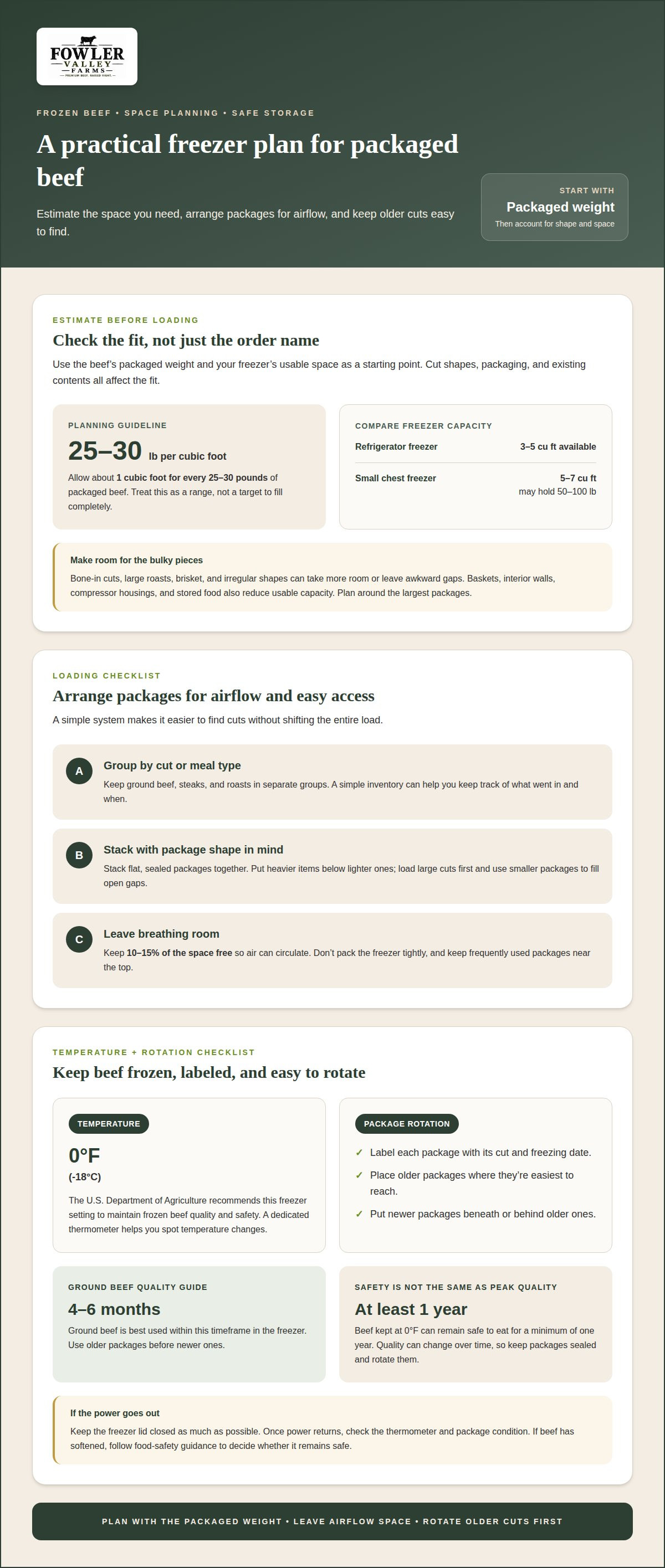
A cubic foot measures volume, not a fixed weight of meat. To estimate how much beef fits in a chest freezer, allow 1 cubic foot for every 25-30 pounds of packaged beef. The amount that fits also depends on packaging and how much open space you leave.
For a capacity calculation, multiply the freezer’s cubic feet by 25-30 pounds, then account for space already occupied. Treat the result as a planning range, not a target to fill completely. A tighter estimate may leave too little room to arrange packages or maintain airflow.
Factors That Affect Usable Space
Usable freezer space can be less than the listed capacity. Baskets, interior walls, compressor housings, and stored food all take up room. Packaging matters, too: flat, sealed ground-beef packs stack differently from rounded roasts or thick steak bundles. If you’re storing mixed cuts, plan around the largest packages, not just the total weight.
A refrigerator freezer’s usable room may be limited, even when the appliance is large. A large side-by-side refrigerator freezer typically has 3-5 cubic feet available for storage. Chest freezers can hold more for their size, but their deep interiors make package arrangement important.
Common Chest Freezer Sizes and Capacity
Capacity labels help compare freezers, while exterior dimensions determine whether one fits in your home. A small chest freezer of 5-7 cubic feet may hold 50-100 pounds of meat.
Measure the space where the freezer will sit, then compare it with the appliance’s exterior dimensions. Interior capacity tells you about storage; exterior measurements tell you whether the freezer will fit in the room.
Organizing and Loading Bulk Beef
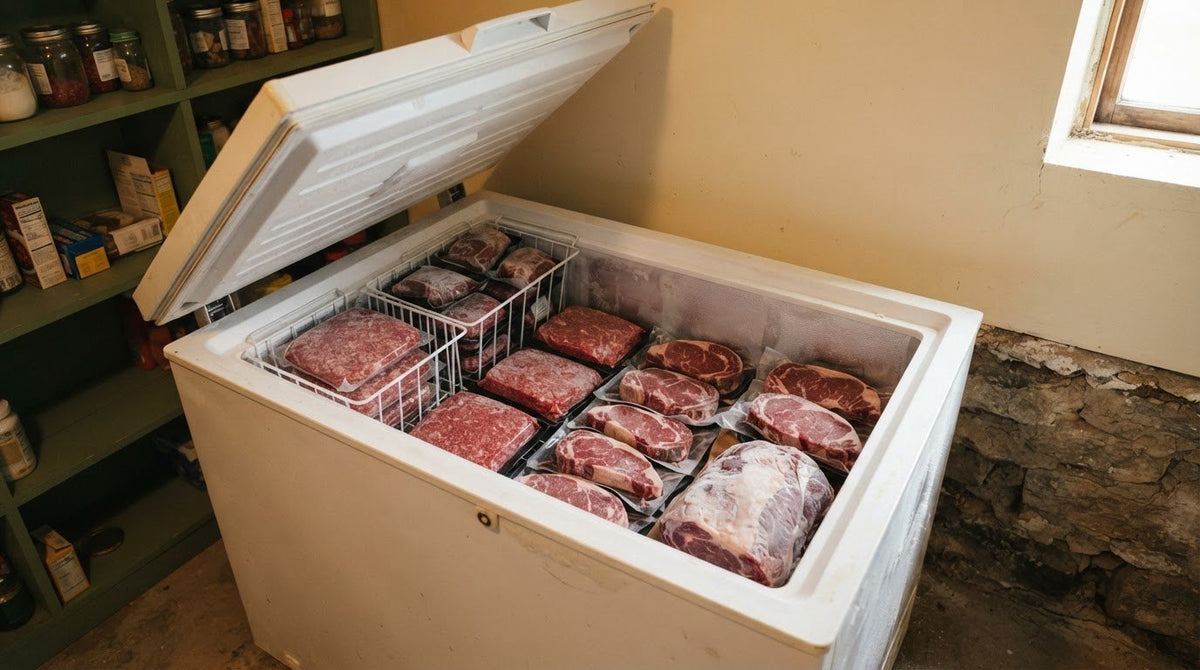
Organize packages by cut or meal type before loading beef. Stack flat, sealed packages together and place heavier items below lighter ones. Keep a simple inventory so steaks, roasts, and ground beef don’t disappear beneath later additions. A clear system helps you find packages without shifting the entire load.
Load large cuts first, then use smaller packages to fill open gaps. Don’t pack the freezer tightly; air needs room to circulate. Leave 10-15 percent of the space free, and keep frequently used packages near the top. A sensible arrangement helps you see what remains and makes the freezer easier to use through the week.
How to Store Frozen Beef Safely and Avoid Overfilling Your Freezer
A steady temperature and sensible arrangement help protect frozen beef. Leave room for airflow, keep packages sealed, and rotate older cuts forward so they don’t get forgotten.
Set a Safe Freezer Temperature
Set the freezer to 0°F (-18°C) to maintain the quality and safety of frozen beef, according to the U.S. Department of Agriculture. A dedicated freezer thermometer makes it easier to spot temperature changes. Place it where you can read it without digging through packages.
Keep the lid closed as much as possible. A closed chest freezer can help keep its contents cold during a power outage. Once power returns, check the thermometer and package condition. If beef has softened, handle it carefully and follow food-safety guidance for deciding whether it remains safe.
Understand Storage Life by Cut
Beef kept at 0°F can remain safe to eat for a minimum of one year. That safety timeframe isn’t the same as peak quality. Freezing slows quality loss, but it doesn’t stop changes in texture or flavor indefinitely. Mark each package with its cut and freezing date to make rotation straightforward.
Ground beef is best used within 4 to 6 months in the freezer. Its texture can show quality changes sooner than larger, intact cuts. Vacuum-sealed packaging helps limit exposure to air, while a torn seal can leave meat more vulnerable to freezer burn. Use older ground beef before newer packages.
Pasture-raised describes how cattle are raised, not how long beef should be stored. Keep the freezer temperature steady and follow the storage guidance for each cut. Labeled packages of ground beef are easier to rotate than unmarked bundles of mixed cuts.
Organize Packages for Easy Rotation
Group packages by cut and meal type. Keep ground beef together, with separate areas for steaks and roasts. A simple inventory can record what went in and when. For example, write each package’s date on a freezer list, then cross it off when you use it.
Place older packages where they’re easiest to reach. Put newer ones beneath or behind them instead of burying earlier cuts. Keep the items you use most near the top of a chest freezer. This reduces rummaging and helps you keep the lid closed while preparing a meal.
Store packages flat when possible. Flat, sealed packs form stable stacks and leave fewer awkward gaps than loosely arranged bundles. Keep labels facing up or out. If a package has no clear cut name or date, label it before storing it with the other frozen beef.
Avoid Overfilling and Protect Airflow
Leave space between packages for airflow. An overpacked freezer makes it harder to add new beef and reach older portions. Don’t force the lid closed against a pile of packages. Instead, arrange items in orderly stacks and keep access to the bottom clear.
Account for baskets, interior walls, and food already in the freezer. These reduce usable space, even if the listed capacity looks ample. Before adding a large order, sort the contents and set aside anything you plan to use soon. Then arrange the new packages without blocking the thermometer or lid.
Large cuts can leave empty pockets around their irregular shapes. Use smaller sealed packages to fill some gaps, but don’t pack them tightly together. Leave enough room to lift out a roast without disturbing every stack. Good organization makes a chest freezer more useful without treating every open inch as storage space.
Keep a Consistent Routine
Set aside time regularly to review your freezer inventory. Move older cuts forward and note packages you plan to use soon. Check the thermometer and inspect package seals for tears or leaks. A brief check helps prevent disorganization before the freezer becomes difficult to use.
After a power interruption, keep the lid closed while checking the freezer’s temperature. After a power interruption, the freezer’s temperature and the food’s condition can vary, so check both rather than relying only on how long the outage lasted. Look for signs of thawing, and use food-safety guidance rather than relying only on the outage’s length.
Match each new order to the space available. Record the date and cut together, use older packages first, and leave room for airflow. This routine helps preserve beef quality and keeps the freezer manageable through every season.
Beef Delivery in Traverse City, Honor, and Nearby Northern Michigan Towns
Fowler & Valley Farms helps Northern Michigan households choose an amount of beef that suits their freezer, whether they’re in Traverse City, Honor, Frankfort, or elsewhere nearby. Beef boxes, a Build Your Own Beef Box, subscriptions, and local delivery give you different ways to plan an order around your meals and storage space.
Start with the room you have, not the size of an order you feel you ought to buy. A household with limited freezer space may prefer a smaller selection of cuts, while a family with a dedicated chest freezer may want to stock more at once. Either way, consider the package shapes and space already taken up by other food. Leave room to arrange packages, reach them, and allow airflow.
Beef Boxes offer a practical way to choose an assortment without planning around a quarter or half share. They can suit a household trying beef from a local farm for the first time, or one looking to replenish useful cuts without filling the freezer all at once. Think about what you cook in a typical week, then choose an order that fits your menu and available storage space.
If you’d rather choose the cuts yourself, a Build Your Own Beef Box lets you tailor the selection to your kitchen. You might choose ground beef for weeknight meals, then add steaks or a roast if you have room. A varied order takes more thought to organize than identical packages, so decide where each type will go before loading the freezer. Keeping similar cuts together makes them easier to find later.
Beef Subscriptions provide another way to plan repeat orders over time. Recurring orders can help you keep beef on hand without storing a large amount at once. This may suit a smaller freezer or a household that wants a steady way to replenish meals. The right option depends on how quickly you use each cut and how much room remains after everyday freezer items are accounted for.
Local delivery serves households across Benzie, Leelanau, and Grand Traverse counties. Free Friday local delivery is available in those counties for orders placed by Thursday. That includes Traverse City and the surrounding Grand Traverse County area, as well as communities near Honor and Frankfort in Benzie County. Saturday pickup is available in Honor.
Plan delivery around the space you’ve made available. Before Friday, clear a place for the packages and group existing beef by cut or meal. When the order arrives, put it away promptly and keep the freezer organized so new packages don’t bury older ones. An inventory on the freezer door can list cuts and dates to help you use them in a sensible order.
For customers outside the local delivery counties, nationwide orders ship frozen in insulated boxes with ice packs. Orders ship Monday and Tuesday. This gives households beyond Traverse City and nearby Northern Michigan towns another way to order beef, while local delivery serves the named counties on its regular Friday schedule.
Choosing an order means balancing the meals you want to cook with the space your freezer can use. Beef Boxes offer an assortment, while a Build Your Own Beef Box lets you select cuts. A subscription can help plan repeat orders. Consider your household size, the cuts you reach for most, and whether your freezer has room for more than the next order. There’s no need to pack it tight. A well-planned order should be practical to store and easy to use.
If you’d like help choosing a beef box for your freezer, contact Fowler & Valley Farms.
Frequently Asked Questions
Chest freezer vs. upright freezer: which is better for bulk beef?
A chest freezer can be a better fit for bulk beef when storage capacity is your main concern. An upright freezer’s shelves make individual packages easier to see and retrieve, which may suit a household that opens the freezer often. Consider how you’ll use the space: stacked packages work well in a chest freezer, while shelves can make different cuts easier to separate and reach.
Can I store a half cow in my refrigerator freezer?
A standard refrigerator freezer usually isn’t practical for a large beef order. It shares space with everyday frozen foods, and shelves or drawers can limit how packages fit. A dedicated freezer gives you more room to keep beef together and organized. Before choosing a large order, consider where each package will go and whether you can reach it without moving other food.
How many pounds of beef fit in a chest freezer by cubic foot?
The estimate depends on usable interior space and how the packages stack. Flat, similarly sized packages leave fewer gaps than bulky roasts or irregular cuts. Use the freezer’s cubic-foot capacity as a starting point, then account for baskets, other food, and the space needed to arrange packages. This estimate is most useful for comparing orders, not as a reason to fill the freezer to the lid.