Grass Fed Grass Finished Beef: What the Terms Really Mean
Two beef labels can sound nearly identical and still describe different feeding histories. Here in Northern Michigan, from Traverse City to Frankfort, we believe it’s worth knowing what “grass-fed” and “grass-finished” actually tell you about grass fed grass finished beef.
It’s easy to assume both terms mean cattle ate grass their whole lives. Grass-fed describes a forage-based diet after weaning; grass-finished describes what cattle ate during the final stage before harvest. But “grass-finished” alone doesn’t tell you whether grain was part of the diet earlier. That distinction matters when you’re comparing labels and deciding what belongs in your freezer.
We’ll explain what each term means, how finishing can affect beef, and what to look for in a sourcing claim. We’ll also cover why flavor and cooking expectations can vary by cut, so you can choose portions that fit the way your household cooks. At Fowler & Valley Farms, we respect both grain-finished and grass-finished approaches. The right choice starts with clear information, not a broad claim on a label.
Key Takeaways
- Read feeding claims closely to understand what they say about an animal’s diet and finishing stage.
- Grass fed grass finished beef descriptions are more useful when they include clear sourcing details, not just broad label language.
- Finishing can influence beef characteristics, but it doesn’t guarantee a particular flavor or quality.
- Plan purchases around the meals your household cooks. Start with familiar cuts and try a new one when it suits you.
- Compare grain-finished and grass-finished beef as distinct choices, then choose what fits your table.
What Does Grass-Fed Grass-Finished Beef Actually Mean?
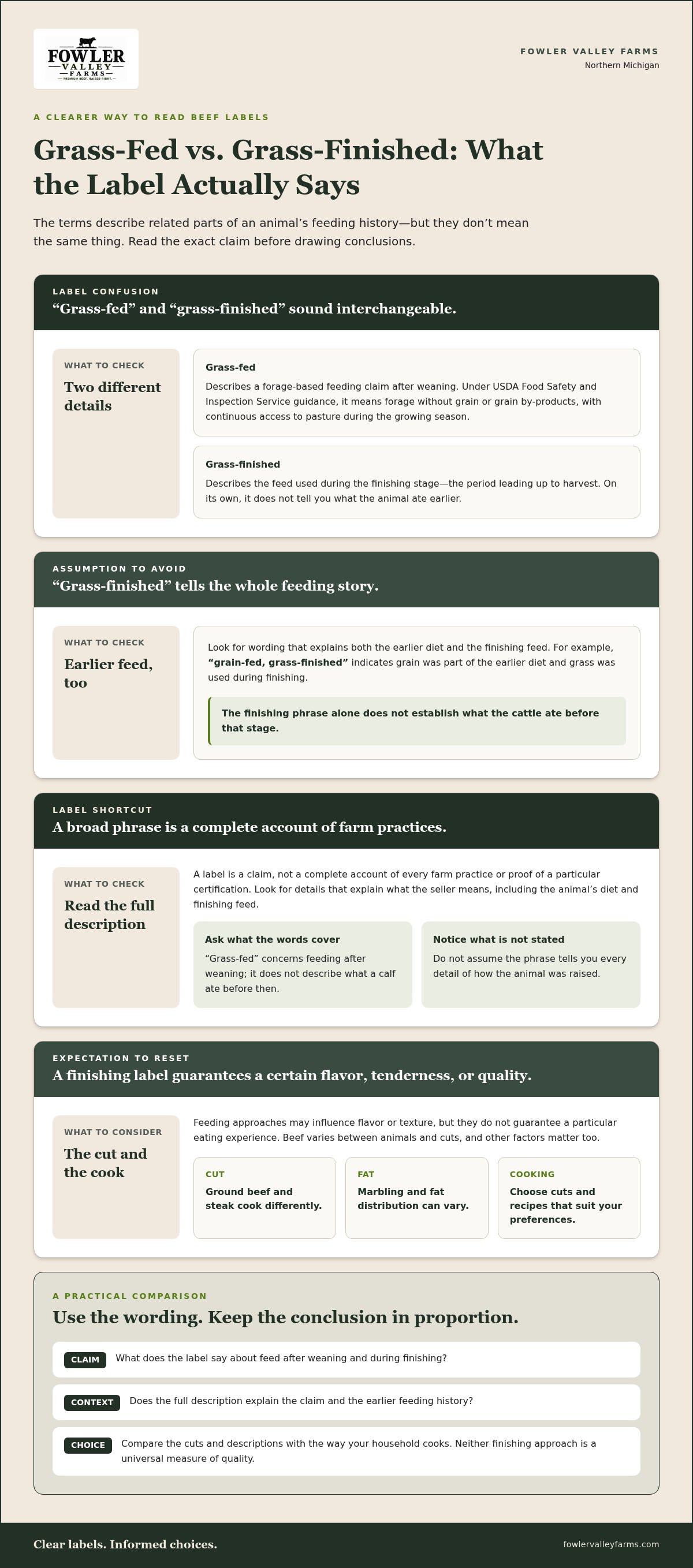
Grass-fed describes what cattle eat; grass-finished describes what they eat during the final stage before harvest. The terms are related, but they don’t mean exactly the same thing. Read both claims in context to get a clearer picture of the animal’s feeding history than you would by treating the phrases as interchangeable.
When comparing grass fed grass finished beef, look beyond the short phrase on the front of a package. Read the full product description and note whether it explains the animal’s diet and finishing feed. A label is a claim, not a complete account of every farm practice or a guarantee of a particular certification.
What does grass-fed mean on a beef label?
Grass-fed is a feeding claim. Under USDA Food Safety and Inspection Service guidance, a grass-fed claim describes cattle fed forage after weaning, without grain or grain by-products, and with continuous access to pasture during the growing season. The phrase concerns feeding after weaning; it doesn’t describe what a calf ate before then.
Look for wording that explains the claim instead of relying on a broad phrase alone. Does the description say “100% grass-fed”? Does it explain what the cattle ate after weaning? Those details help you understand what the seller means. Don’t assume “grass-fed” tells you about every stage of an animal’s life, how it was raised in other respects, or whether a third party certified the claim.
What does grass-finished add to the description?
Grass-finished refers to the feed used during the finishing stage, the period leading up to harvest. It tells you that grass remained the finishing feed. On its own, though, the phrase doesn’t establish what the animal ate earlier. A description such as “grain-fed, grass-finished” can indicate that grain was part of the earlier diet and grass was used for finishing.
Together, “grass-fed” and “grass-finished” communicate more than either term in isolation: one describes the feeding claim after weaning, and the other makes the final feeding stage explicit. The wording still needs context. Check whether the description explains the claim instead of assuming every seller uses the phrase to describe the same full history.
Careful label reading helps whether you’re comparing a single cut or planning several meals. As you browse our beef selection, separate the label’s exact wording from your expectations about flavor, cooking, or quality. Those can vary by cut and other factors. Feeding terms alone don’t promise a particular result. In our Northern Michigan family business, we see grain-finished and grass-finished beef as distinct choices, not a simple ranking. Understanding the words helps you decide which description fits what you’re looking for.
How Feeding and Finishing Shape Beef Without Telling the Whole Story
Feeding and finishing are part of how beef is raised, but they aren’t a complete measure of what ends up on your plate. A label describes a practice, not every quality of the beef. It can help you understand one part of the animal’s production story, but it can’t promise a particular eating experience or tell you everything about how a farm operates.
Beef comes from individual animals, and different cuts serve different purposes. A label may describe a feeding approach, while the cut, its fat, how it’s handled, and how you cook it all help shape the meal. The words on the package are a starting point, not a guarantee.
What can a finishing description help you understand?
A finishing description tells you about the feed used during a particular stage. By itself, it doesn’t establish other details about the farm, its land stewardship, or how the beef will taste. For a fuller account of a producer’s practices, look for clear explanations beyond the short claim. A third-party standard can offer another reference point: the American Grassfed Association (AGA) explains its own standards and certification.
Feeding approaches may influence characteristics such as flavor or texture, but those qualities can vary between animals and cuts. Ground beef and steak aren’t interchangeable cooking experiences, even when their feeding descriptions are the same. Nor should you expect every grass-finished steak to look or taste identical. Consider what you like to cook and eat, then compare descriptions with those preferences in mind.
Why grass-finished does not automatically mean better for everyone
Some households specifically prefer grass-finished beef, and that’s a reasonable choice. Others may prefer a different finishing approach. Neither preference needs to become a universal claim about health or quality. A finishing label alone doesn’t prove that one beef is healthier, more tender, or better suited to every table.
Marbling is one feature shoppers may consider, but it isn’t the whole story. The amount and distribution of fat can vary, and the cut and cooking method matter. A label won’t settle every question about the finished meal. If you enjoy a leaner profile, choose cuts and recipes that suit it. If you prefer more richness, compare the cuts themselves rather than relying on a broad feeding claim to predict the result.
We take a practical view at Fowler Valley Farms. Grain-finished and grass-finished beef are distinct choices, and we don’t consider one method a universal measure of quality. What matters is understanding the claim and choosing beef that fits your household’s cooking habits. You can browse our beef with those preferences in mind, comparing individual cuts and descriptions without expecting one label to tell the whole story.
How to Compare Grass-Finished Beef Claims Before You Buy
A useful comparison starts with the words a seller actually uses, then separates the feeding claim from the cut and package you’re considering. Broad phrases can sound reassuring, but specific details make listings easier to compare. Use the same framework each time, whether you’re shopping farm-direct or at a grocery store. The route to market gives sourcing context; it doesn’t establish an animal’s feeding history by itself.
Which questions help clarify the label?
First, copy the feeding claim as written. Does it describe grass-fed, grass-finished, or both? Next, look for sourcing details that identify who raised or supplied the beef. A phrase such as “pasture raised” may offer context, but without a clear explanation, don’t treat it as proof of a specific diet, finishing practice, or certification. When comparing grass fed grass finished beef, read the complete description rather than relying on a short headline.
Keep your notes side by side. A plain explanation can be more useful than a string of broad terms because it gives you something concrete to compare. If a claim is unclear, record it as unclear rather than filling in the blanks yourself.
| What to compare | Listing A | Listing B |
|---|---|---|
| Exact feeding claim | Copy the wording as shown | Copy the wording as shown |
| Source details | Who raised or supplied it? | Who raised or supplied it? |
| Cut | Write the named cut | Write the named cut |
| Pack format | Individual cut, curated box, or custom box | Individual cut, curated box, or custom box |
How should you compare cuts and product formats?
Compare like with like. A grass-finished ribeye and a pack of ground beef differ in cut and use, so they won’t tell you much about how two sellers describe the same offering. Match the cut first, then compare the exact feeding language, source details, and pack format. That keeps a different cut or package from muddying the comparison.
Also consider how your household buys and cooks beef. Individual cuts suit a specific meal. A curated box offers a selection, while a custom box lets you choose around familiar meals. Farm-direct and grocery-store options can present sourcing information differently, so evaluate the details provided instead of assuming the channel tells the whole story.
Once you know which cuts and format fit your table, browse our beef cuts and options. Compare the product descriptions with the meals you plan to make, then choose a quantity that feels practical for your household.
Choosing and Cooking Grass-Finished Beef for Your Household
Start with the meals you already make. A freezer works best when its contents fit your real routine, not an idealized meal plan. In Northern Michigan, that might mean ground beef for a weeknight skillet, a roast for Sunday supper, or steaks for a meal you’ve set aside time to cook. The feeding description can help you compare products, but the cut and your cooking habits guide what to bring home.
Which cuts suit the meals you already cook?
Use this simple order to build a practical mix:
- List the meals you make most. Think tacos, burgers, pasta sauce, or soups for ground beef, and planned meals for steaks or roasts.
- Choose familiar cuts first. Let your recipes, household size, and comfort in the kitchen guide the amount and kind of beef you select.
- Add one new cut to try. Pick something that fits a meal you already know how to make, rather than filling the freezer with unfamiliar choices.
Cooking depends on the cut. Ground beef, a steak, and a roast need different methods, so follow guidance suited to the cut and recipe. If a cut has less visible fat, take care not to overcook it. That can help avoid dryness, though results depend on the cut and how it’s prepared. There isn’t one temperature or cooking time that fits every piece of beef.
How can you make a beef box work for your freezer?
Build your selection around meals you’ll actually prepare. If ground beef is a regular part of your week, make room for it. Add cuts suited to the roasts or steak suppers your household enjoys, and be honest about how often you’ll cook them. A balanced box is one that gets used, not one that simply sounds varied.
At Fowler Valley Farms, our Build Your Own Beef Box lets you choose cuts around your household’s preferences. The same practical questions help whether you’re selecting individual cuts or putting together a larger freezer supply. Think about who you’re cooking for, how much room you have, and which recipes are already in rotation.
For a little more background as you consider where your beef comes from, our family’s story is part of that context. We’re a multi-generational family farm, and we believe shoppers deserve plain information about the choices behind their food. You can explore our family farm background alongside product details, without assuming a farm’s story proves a particular feeding claim.
Choose cuts that fit the season and your table, whether you’re planning a hearty winter supper or stocking up for familiar weeknight meals. If you’re in Traverse City, Frankfort, Leelanau County, or elsewhere in Northern Michigan and are ready to choose beef for your household, explore our beef options and start with the cuts you know you’ll cook.
A Family-Farm Perspective on Grass-Fed Grass-Finished Beef
At Fowler Valley Farms, raising and selling beef is part of our family’s work across generations. We know the words on a package can carry a lot of weight, especially when you’re deciding what to serve at home. Our view is straightforward: grain-finished and grass-finished beef are different choices, and neither is automatically right for every household.
We believe a good decision starts with clear information. Read the feeding claim as written, look at the sourcing details, then consider the cut and how you plan to cook it. A description can help you understand one part of the beef’s story. Your preferences and kitchen routines help fill in the rest.
How our family thinks about choosing beef
We respect families who prefer grass-finished beef, just as we respect those who choose grain-finished beef. Finishing describes a feeding approach, not a promise that every steak or roast will suit every cook. Compare the claim with the cut in front of you and decide based on what matters to your table.
Our family’s background is part of how we approach this work. You can learn more about our family farm and its story, then use the same care when reading any beef description. Clear words matter. So does choosing a cut you’ll feel comfortable preparing.
Make your next beef order fit the way you cook
Think through the meals you make in a usual week. If ground beef is a regular ingredient, include it in your plan. If you often cook a roast for Sunday supper or steaks for a special meal, consider those cuts too. Then choose a quantity that suits your household and freezer space. That practical approach can make grass fed grass finished beef, or any beef you’re considering, easier to compare and use.
A custom box can bring your household’s preferences together in one order. Start with familiar cuts, then add something you’d like to try when you have a recipe in mind. You don’t need to build a freezer around someone else’s idea of the perfect assortment. Choose what fits your cooking, your people, and the meals you look forward to making.
We want you to feel informed, not pushed toward one finishing method. Use the label and sourcing details to understand the claim, then let your preferred cuts and cooking habits guide your order. Build a beef box that fits your table.
Choose Beef That Belongs in Your Kitchen
You don’t have to settle every question about beef before planning your next meal. Let your priorities guide the choice: the feeding description you’re comfortable with, the cut you enjoy cooking, and the amount that makes sense for your household. Grass fed grass finished beef is one option to consider, not a rule every family needs to follow.
Keep the next step simple. Pick a familiar meal, decide what cut would serve it well, and buy an amount you can use. As your cooking habits change, so can the mix you choose. Good food decisions should work in an ordinary week, not just for a special occasion.
We’re glad to help you make that choice at Fowler Valley Farms. Build a beef box around the cuts your family enjoys, with local delivery available for customers in communities including Traverse City, Frankfort, Grand Rapids, Leelanau County, and Kalkaska.
Frequently Asked Questions
Can grass-fed beef be used in the same recipes as other beef?
Yes. Most recipes can be adapted to the cut you have, whether you’re making burgers, a roast, or a steak dinner. Check the recipe against the cut and its thickness instead of assuming every piece cooks alike. If you’re trying grass-fed grass-finished beef for the first time, use a familiar recipe and keep a close eye on leaner cuts. A simple note about the cut and cooking method can help you adjust next time.
How do I keep grass-finished beef from drying out?
Choose a cooking method suited to the cut, and pay attention to doneness rather than relying on the clock alone. For ground beef, avoid cooking it longer than the recipe calls for. For steaks or roasts, follow a reliable recipe written for that cut and use its recommended method. If you’re cooking for guests, try the recipe ahead of time so you can get comfortable with the process.
Can I choose individual cuts instead of buying a set beef box?
Yes. Fowler Valley Farms offers individual beef cuts, beef boxes, and a Build Your Own Beef Box. That gives you options for planning around the meals your household actually makes. From Traverse City and Frankfort to Grand Rapids and other Northern Michigan communities, you can browse the current beef selection, then choose individual cuts or use the custom box builder to put together a mix that suits your recipes and freezer space.