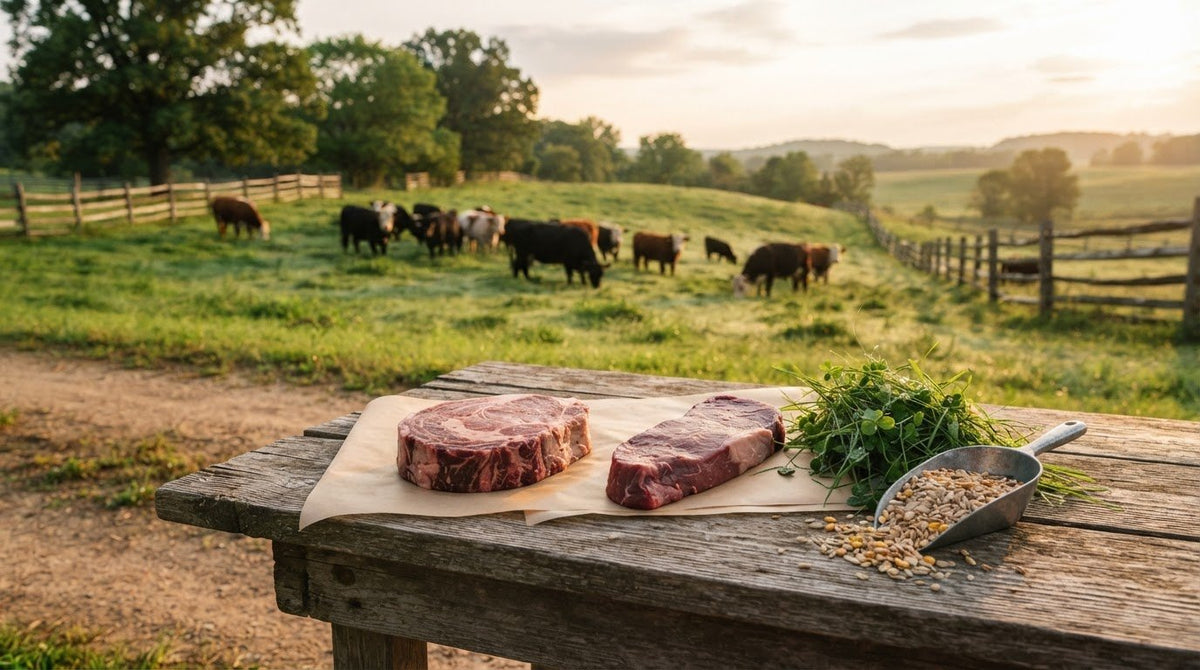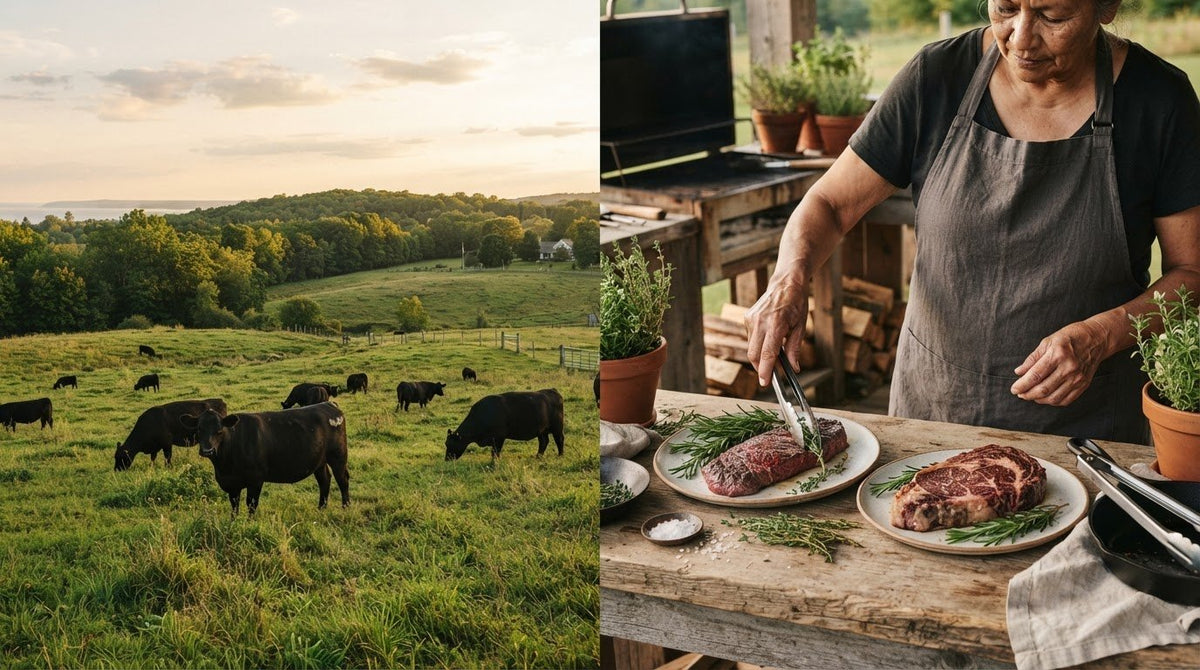
Grass Fed vs Grain Fed Beef: How Taste and Cooking Compare
Grain-finished beef can still come from cattle that spent time on pasture. In the grass-fed vs. grain-fed beef comparison, the key difference is how cattle are finished: grass-finished beef is generally leaner and more pronounced in flavor, while grain-finished beef usually has more marbling and a sweeter taste. Neither is automatically better. The right choice depends on the flavor and cooking experience you prefer.
It’s natural to expect a label to tell you how beef will taste, but the finishing stage matters, too. From a summer cookout in Traverse City to a winter meal in Benzie County, the cut and cooking method can shape your choice. Some cattle graze before a period of grain finishing, so the choice isn’t always simply pasture or grain from the start.
This comparison covers flavor, texture, cooking, environmental trade-offs, and what grain finishing after pasture means. You’ll get a practical way to choose beef for the meals you like to cook, whether you prefer a leaner steak with a stronger character or a more marbled cut with a milder, sweeter taste.
Key Takeaways
- Compare cattle growth and carcass traits to understand why feeding systems can produce different cuts.
- Weigh environmental impacts by the measure that matters to you, since the trade-offs vary across categories.
- Choose cooking methods with a cut’s leanness in mind to help preserve tenderness and moisture.
- Look beyond the grass-fed or grain-fed label: some cattle graze before grain finishing.
- Use nutrition details as one part of your decision; both types provide protein, vitamins, and minerals.
How Does the Flavour and Quality Compare?
Feeding and finishing influence cattle growth, carcass traits, and beef character. A California beef-systems study offers one measured comparison. For cooks in Northern Michigan, its findings provide context, not a promise about every cut.
Grass-Fed Cattle Growth and Carcasses
Grass-finished cattle continue on forage through finishing, and raising them generally takes a whole year longer. In the California study, the GF20 grass-fed treatment reached a final body weight of 478 kg, a dressing percentage of 50.2%, and a marbling score of 285. These measurements describe that study’s treatment, not every grass-finished animal or the beef a family might serve in Traverse City.
Grain-Fed Cattle Growth and Carcasses
Grain-finished cattle in the United States typically spend 4-6 months at a feedyard, eating grains, local feed ingredients, and hay or forage. In the California study, the grain-fed CON treatment reached a final body weight of 632 kg. That result differs from GF20’s final weight, but the reported dressing percentage and marbling score above apply to GF20, not CON.
Grass-Fed Beef Nutrition
Grass-fed beef usually has fewer calories and more vitamins A and E and omega-3 fatty acids than grain-fed beef. Both types provide protein, vitamins, and minerals such as zinc and iron. In the comparison, raw grass-finished beef had 2.06 grams of total fatty acids per 100 grams, compared with 3.89 grams in raw grain-finished beef. These values describe total fatty acids, not a full nutrition profile.
According to the U.S. Department of Agriculture, a cooked fresh meat cut qualifies as lean when it has less than 10 grams of total fat, 4.5 grams or less of saturated fat, and less than 95 mg of cholesterol per 100 grams and per reference amount customarily consumed. That reference amount is 85 grams (3 oz). These are lean-claim nutrition criteria, not a definition of grass-fed beef.
Cattle Diets and Finishing
In regions with winter, grass-fed cattle may also eat hay, baleage, and other plants. Grain-finished cattle may graze earlier in life, then receive grain during finishing. For Northern Michigan households comparing labels through changing seasons, that distinction matters: finishing describes the final production stage, not necessarily every feed an animal ate. Consider the stated finishing method alongside the cut you plan to cook.
| Option | Typical finishing diet | Study result | Useful distinction |
|---|---|---|---|
| Grass-finished | Forage, including hay or baleage in winter regions | GF20: 478 kg final body weight | Longer growth; often leaner |
| Grain-finished | Grains, local feed ingredients, hay or forage | CON: 632 kg final body weight | Often more marbling and a sweeter taste |
Choose based on the flavor and leanness you prefer, and compare finishing details. You can browse beef cuts when considering options for your next meal.
Environmental trade-offs
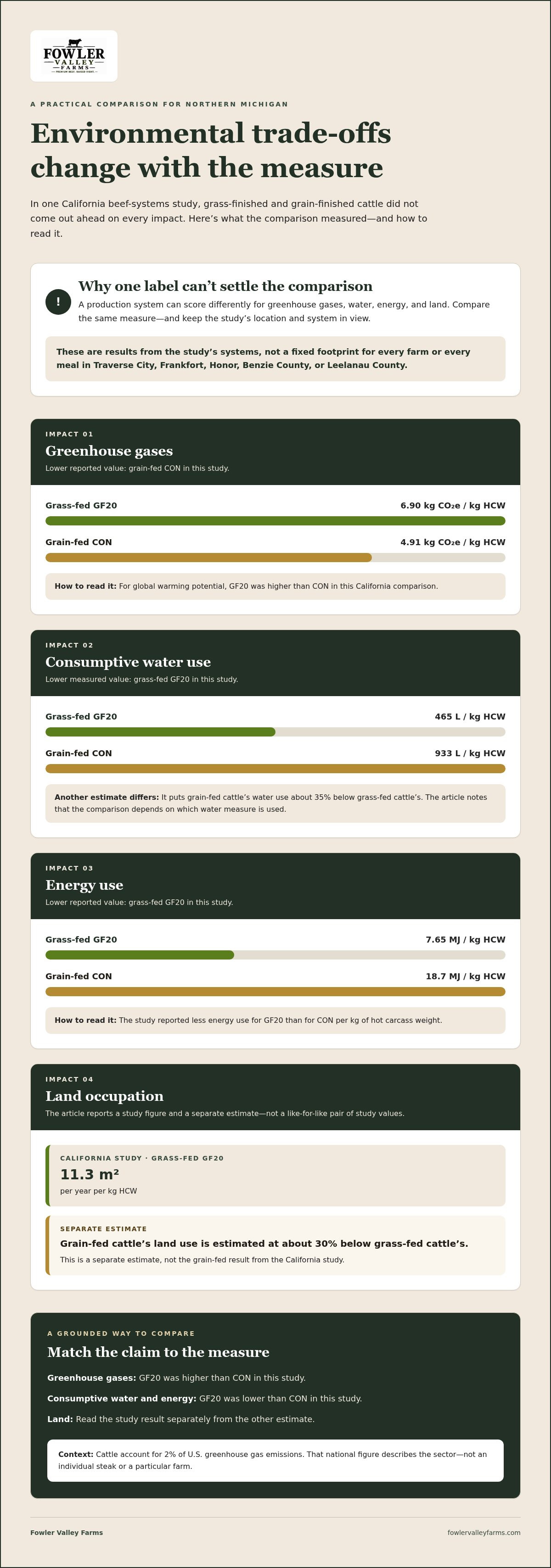
Environmental comparisons depend on the impact measured and the production system studied. For households in Traverse City or Frankfort, the label alone won’t settle every comparison. A California beef-systems study found different results for greenhouse gases, water, and energy, illustrating why each measure needs context.
For global warming potential, the study reported 6.90 kg CO₂ equivalent per kg of hot carcass weight (HCW) for the GF20 grass-fed treatment. Grain-fed CON measured 4.91 kg CO₂ equivalent per kg HCW. These are results for the study’s systems, not a fixed footprint for every farm or every meal in Northern Michigan.
Water use pointed the other way. GF20 used 465 L of consumptive water per kg HCW, compared with 933 L for grain-fed CON. A separate estimate puts grain-fed cattle’s water use about 35% below grass-fed cattle’s. The comparison depends on what water measure is used, so readers in Benzie County should look for the metric behind any claim.
Consumptive water use is one specific measure, not a complete account of water use. Feed sources and growing conditions also shape the results. A California study can help explain a trade-off, but it doesn’t establish the impact of beef produced in Northern Michigan. The region named in a comparison matters.
Energy use favored GF20 in the study: 7.65 MJ per kg HCW, compared with 18.7 MJ for grain-fed CON. Land occupation for GF20 was 11.3 m² per year per kg HCW. Another estimate puts grain-fed cattle’s land use about 30% below grass-fed cattle’s. Those findings address different parts of production, so neither one figure tells the whole story for a household choosing beef in Leelanau County.
The study’s attributional beef life-cycle assessment followed ISO 14040 standards. Its framework helps explain how impacts were assessed, but results still depend on the system and boundaries used. When comparing claims for beef available near Traverse City, match the measure first: greenhouse gases, water, energy, or land. A single headline number can hide trade-offs across categories.
- Greenhouse gases: California’s GF20 result was higher than grain-fed CON in this study.
- Water: GF20 used less consumptive water than CON in this study, while a separate estimate favors grain-fed systems.
- Energy: GF20 used less energy per kg HCW than CON in this comparison.
- Land: GF20 occupied 11.3 m² per year per kg HCW; another estimate puts grain-fed land use lower.
For context, cattle account for 2 percent of U.S. greenhouse gas emissions. That national figure describes the sector, not an individual steak or a particular farm. Whether you’re weighing options in Frankfort or elsewhere, compare systems using the same metric and boundary, then consider which trade-off matters most to you.
Flavor and cooking differences
Grass-finished and grain-finished beef can taste and cook differently because their fat and marbling differ. Whether you’re using a pan or grill, that affects how closely you’ll want to watch each cut.
Grass-Fed Beef Flavor and Cooking
Grass-fed beef is often described as having a stronger, sometimes gamey flavor similar to venison. Its lower fat content can also make it easier to overcook into a firm, dry steak. A lean grass-fed sirloin, for example, benefits from careful cooking and close attention as it approaches your preferred doneness.
Watch the surface and center rather than relying only on a fixed cooking time. A thin steak cooks differently from a thick one, and a lean cut has less fat to help maintain moisture. Avoid cooking past your preferred doneness, as overcooking can make grass-fed beef tougher. These differences matter most with simply prepared steaks, where the beef’s flavor and texture stand on their own.
Grain-Fed Beef Flavor and Cooking
Grain-fed beef usually has more marbling and a sweeter taste than grass-fed beef. The small streaks of fat within a cut, such as a grain-finished ribeye, soften as it cooks and contribute to a richer, juicier bite. This familiar profile suits diners who prefer a milder flavor.
Marbling gives you some room for error, but it doesn’t make a steak impossible to overcook. Choose a grain-finished ribeye for a rich, tender result, or a leaner cut if you prefer less visible fat. On the grill, watch for flare-ups as fat renders. In a skillet, let the surface brown without leaving the steak unattended.
Across the United States, grass-fed beef generally costs more than grain-fed beef. The difference depends on the cut and market, so compare like with like, such as ribeye against ribeye.
- For a stronger, leaner profile: Choose grass-fed beef and cook it carefully to help preserve moisture.
- For a milder, richer bite: Grain-fed beef’s greater marbling and sweeter taste may suit your plate.
- For a fair price comparison: Compare the same cut rather than different cuts with different levels of marbling.
Cut thickness, starting temperature, and cooking method all affect the result. With either type, turn the steak as needed and use its appearance and feel as cooking clues. A lean grass-fed sirloin calls for closer attention than a marbled grain-finished ribeye. Choose based on the flavor you enjoy and the care you’re willing to give it at the stove or grill.
Grain finishing after pasture
Beef production doesn’t always mean pasture or grain from birth onward. Some cattle graze first, then receive grain during finishing. Both types of beef provide protein, vitamins, zinc, and iron.
Pasture Before Grain Finishing
Grain finishing after pasture means cattle spend part of their lives grazing before moving to a feedyard. In one study, CON steers grazed before spending 128 days in a feedyard. That sequence differs from cattle finished entirely on forage, and the final label alone may not describe every stage of an animal’s diet.
A separate study treatment, GR45, involved steers grass-fed for 20 months, followed by a 45-day grain finish. Grain made up 11% of lifetime feed for grain-finished cattle in the cited comparison. These examples show why it helps to distinguish the full raising system from the finishing stage. A short grain finish after pasture is not the same feeding history as a longer feedyard period.
For U.S. grain-finished cattle, the typical feedyard finishing period is 4-6 months, with grain, local feed ingredients, and hay or forage in the diet. Grass finishing typically lasts 6-10 months. Those stages describe common timelines, while the 128-day and 45-day examples show different study protocols. Read the wording carefully: “grain-finished” refers to the finishing diet, not necessarily an animal’s entire life.
When comparing labels, look for whether the description identifies the finishing method or the animal’s broader diet. “Pasture-raised before grain finishing,” for example, describes a sequence. “Grass-finished” describes a forage-based finish. This distinction helps explain why two beef products may both come from cattle raised on pasture yet carry different finishing claims.
Grain-Fed Beef Health Effects
Nutrition facts describe what beef contains; they don’t, by themselves, establish a health benefit or risk for every eater. Grass-fed beef is usually lower in calories and higher in vitamins A and E and omega-3 fatty acids than grain-fed beef. Both provide protein, vitamins, and minerals such as zinc and iron.
For a practical comparison, use the nutrition information for the specific cut and serving you plan to eat. A lean cut and a more marbled cut can differ in fat and calories, regardless of the animal’s finishing history. Cooking method matters, too: added butter or oil changes the meal’s overall nutrition, while trimming visible fat changes what reaches the plate.
Keep the production question separate from the nutrition question. Whether cattle grazed before a grain finish tells you about their feeding sequence. The cut’s nutrition information helps you compare nutrients in the beef itself. Neither detail alone answers every health question, but both make your choice more informed.
How do grass-fed and grain-fed beef differ in nutrition, calories, and fat?
Both types provide protein, vitamins, and minerals, but their fat profiles can differ. The figures below compare fatty acids in raw beef, not every nutrient in a cooked serving.
In the comparison, raw grain-finished beef contained 3.89 grams of total fatty acids per 100 grams. Raw grass-finished beef contained 2.06 grams per 100 grams. That difference helps explain why grass-finished cuts are often leaner, while grain-finished cuts may carry more fat and calories. The exact nutrition of a meal also depends on the cut and preparation.
The fatty-acid profile also differed. Monounsaturated fatty acids, or MUFA, made up 49% of total fatty acids in grain-finished beef and 44% in grass-finished beef. Saturated fat accounted for 32% of total fatty acids in grain-finished beef. Those percentages describe each profile’s share, not grams of fat in a serving.
| Measure | Grass-finished beef | Grain-finished beef |
|---|---|---|
| Total fatty acids per 100 g raw beef | 2.06 g | 3.89 g |
| MUFA share of total fatty acids | 44% | 49% |
| Saturated fat share of total fatty acids | Not provided in this comparison | 32% |
| General nutrition pattern | Usually fewer calories; more vitamins A and E and omega-3 fatty acids | Usually more total fatty acids |
Grass-fed beef usually has fewer calories and more vitamins A and E and omega-3 fatty acids than grain-fed beef. Both types provide protein, zinc, iron, and other nutrients. These broad patterns don’t mean every grass-finished steak will have the same nutrition as another; cut and visible fat affect what lands on your plate.
For a fair comparison, use the same cut and preparation. Compare raw with raw or cooked with cooked, and check the serving size. A lean grass-finished sirloin and a marbled grain-finished ribeye aren’t equivalent cuts. Trimming visible fat or adding cooking fat also changes the meal’s totals.
About one-third of beef’s saturated fat is stearic acid. That detail puts the saturated-fat category in context, but the full nutrition picture also includes serving size, total fat, and the other nutrients in the meal. Use the specific cut’s nutrition information rather than assuming the feeding label tells the whole story.
Use these figures to guide your comparison, then explore beef options that fit the cuts and meals you prefer.
Fowler & Valley Farms: Build Your Own Beef Box
Fowler Valley Farms offers a Build Your Own Beef Box, so you can choose cuts for your household. After comparing grass-finished and grain-finished beef, use the box to select the cuts you prefer for the meals you cook.
If you prefer a set selection, Beef Boxes offer another way to bring beef home. Beef Subscriptions suit households looking for recurring orders, and Local Delivery is available for orders in the farm’s delivery area. These options let you match how you buy with how you cook, without treating one finishing style as right for everyone.
Visit fowlervalleyfarms.com to explore the Build Your Own Beef Box and other beef options.
Choose Beef for the Meals Ahead
Let the meals you enjoy guide your next choice. Think about the cuts you reach for, how you like to cook them, and the flavor you want at the table. The grass-fed vs. grain-fed beef decision doesn’t need to be a permanent rule for your kitchen. Start with a cut that suits a meal you already know how to make, then try another style when you’re ready.
That’s a practical way to learn your preferences. A steak for the grill, beef for a slow-cooked supper, and ground beef for a weeknight meal each have their place. Choose with your cooking habits in mind, not just a label. Your table, your taste, your call.
If you’d like help choosing beef for your household, contact Fowler & Valley Farms. We’re glad to help you take the next step with confidence.
Frequently Asked Questions
Should I Order Grass Fed Beef or Grain Fed Beef?
Choose based on the meals you cook and the flavor you enjoy. If you’re ordering for a household with different preferences, start with familiar cuts rather than buying every cut in one style. For example, choose ground beef for everyday meals and a steak cut for a dinner where you can compare the flavors directly. When weighing options from suppliers like Fowler & Valley Farms, the grass-fed versus grain-fed beef decision is a matter of preference, not a rule.
What's the Environmental Impact of Each Type of Beef?
No single environmental measure settles the comparison. A useful assessment looks at the full production system, including cattle raising, feed production, and processing, then compares the same impacts using the same boundaries. A study measuring water use alone, for example, won’t answer a question about greenhouse gases or land. Region matters, too: feed sources and growing conditions differ across the United States.
What does grass-fed beef mean in the United States?
In everyday U.S. labeling, “grass-fed” describes cattle finished on forage rather than grain. In places with cold winters, forage can include hay, baleage, and other plants. The term alone doesn’t mean the beef is free of added hormones or antibiotics. If those details matter to your buying decision, look for each claim separately rather than assuming one label covers every aspect of how cattle were raised.
What does grain-fed or conventional beef mean?
Grain-fed beef comes from cattle whose diet includes grain during finishing. That doesn’t necessarily mean cattle ate grain throughout their lives: they may graze before moving to a feedyard. A finishing diet can also include local feed ingredients, hay, or forage. “Conventional” is a broader description, so it doesn’t identify every detail of an animal’s feed or raising history on its own.
How do grass-fed and grain-fed beef differ in taste and texture?
Grass-fed beef tends to have a more pronounced flavor and leaner texture, while grain-finished beef is often milder and richer. For a fair comparison, try the same cut prepared the same way rather than comparing a lean sirloin with a marbled ribeye. Simple seasoning makes differences easier to notice. Your preference may depend on whether you like a beef-forward taste or a buttery bite.
How do their cooking times and best cooking methods compare?
Cooking time depends more on a cut’s thickness, starting temperature, and cooking method than on a single grass-fed or grain-fed rule. Leaner steaks need close attention because extra cooking can make them firm and dry. For a useful kitchen comparison, cook similarly sized steaks in the same pan or over the same grill heat, then check them as they cook instead of relying on identical timing.
How do grass-fed and grain-fed beef compare in environmental impact and animal welfare?
Environmental impact depends on the measure and production system being compared; the label alone can’t describe every effect. Animal welfare is a separate question. A feeding label doesn’t tell you about cattle handling, health care, transport, or living conditions. For a clearer picture, consider those practices individually and distinguish what the beef label tells you from what it leaves unanswered.
What is the average price difference between grass-fed and grain-fed beef in the U.S.?
Price varies significantly based on the specific cut, packaging size, distribution model, and whether you purchase from local producers like Fowler & Valley Farms or major supermarkets. Generally, grass-fed beef carries a higher price tag than conventional grain-fed beef due to the longer raising timeline, more land use, and smaller overall production scale required for forage-finished cattle.