
How to Buy Meat From a Local Farmer Near You
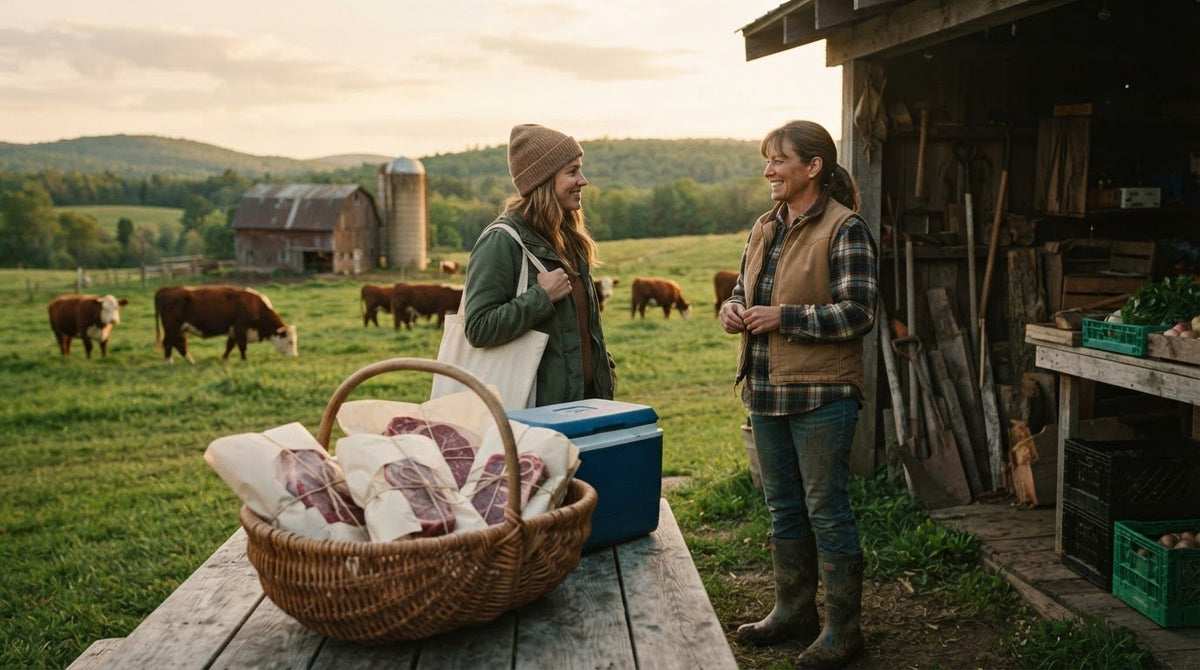
Start with a farmers market’s online vendor directory, then ask nearby farms what cuts or bulk shares they sell and whether you can collect your order or have it delivered. That’s a practical first step in how to buy meat from a local farmer. A directory can help you find sellers before you plan a drive around Honor, Traverse City, Frankfort, Benzie County, or Leelanau County.
Buying directly from a farm gives you a chance to learn about the meat and choose an order that fits your household. Individual cuts let you try a few favorites; a bulk share usually includes a mix of steaks, roasts, and ground beef. Compare available products, pickup or delivery arrangements, and the amount of meat you want to store.
This guide walks you through finding farms and meat sellers, comparing individual cuts with bulk shares, and asking clear questions about how animals are raised. You’ll also learn how hanging weight differs from take-home weight, what to consider when choosing cuts and packaging, and how to plan for pickup before placing an order.
Key Takeaways
- Use farmers market vendor directories to identify nearby meat sellers before planning a visit.
- Compare individual cuts with a bulk share based on the variety of cuts you want and how much freezer space you have.
- Ask about where animals are raised, what they’re fed, and whether the seller raises or resells the meat.
- Understand how hanging weight differs from the packaged meat you take home before comparing bulk orders.
- Find out how cut choices, packaging, and pickup or delivery are arranged before placing an order.
Individual retail cuts versus bulk meat shares
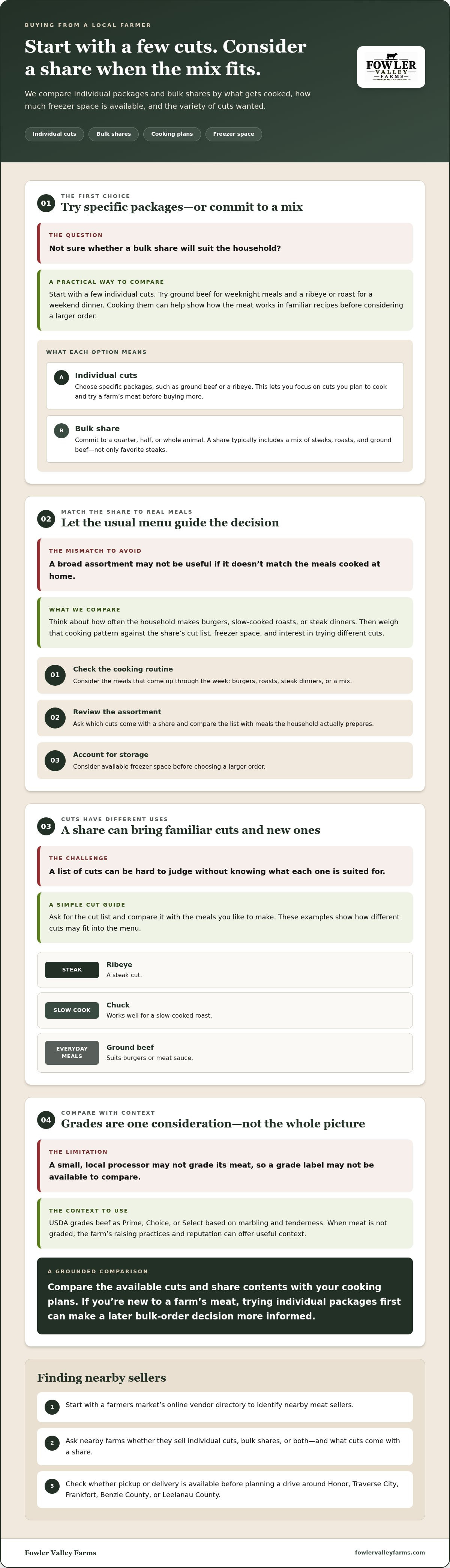
At a farmers market, ask the meat vendor whether they sell individual cuts, bulk shares, or both. Individual packages let you choose the cuts you plan to cook. A bulk share usually means committing to a quarter, half, or whole animal. The right choice depends on your household’s cooking habits, freezer space, and interest in trying different cuts.
Start with a few individual cuts if you’re new to a farm’s meat. For example, buy ground beef for weeknight meals and a ribeye or roast for a weekend dinner. Cooking those cuts helps you learn how the meat works in your recipes before considering a larger order. Ask which cuts are available and whether the vendor raises the animals or sources meat from other farms.
A bulk share offers a broader mix than a selection of only favorite steaks. A quarter, half, or whole share typically includes steaks, roasts, and ground beef. That variety can suit households that cook different meals throughout the week. Before committing, consider how often you make burgers, slow-cooked roasts, or steak dinners. Your usual menu can help you decide whether the assortment will work at home.
- Individual cuts: Choose specific packages, such as ground beef or a ribeye, and try them before buying more.
- Bulk share: Commit to a quarter, half, or whole animal and plan for a mix of beef cuts.
- First conversation: Ask the seller which options they offer and what cuts come with a share.
Beef cuts serve different purposes. Ribeye is a steak cut, chuck works well for a slow-cooked roast, and ground beef suits burgers or meat sauce. A share can combine familiar choices with cuts you may not usually select. Ask for the cut list so you can compare the assortment with meals you actually prepare.
USDA grades beef as Prime, Choice, or Select based on marbling and tenderness. Grading is one consideration, but a small, local processor may not grade its meat. In that case, the farm’s raising practices and reputation offer useful context. To decide how to buy meat from a local farmer, compare the available cuts and share contents with your cooking plans. Trying individual packages first can help you make a more informed bulk-order decision.
Sampling a few cuts at a farmers market lets you try a farmer’s meat before deciding whether to buy a bulk share. It’s a way to focus your first purchase on individual cuts rather than making a larger commitment right away.
Bulk meat means purchasing a whole, half, or quarter of an animal, typically with a mix of steaks, roasts, and ground beef. Before committing to a share, consider whether that assortment suits your cooking plans and freezer space.
Questions to ask farmers about animal-raising practices
Ask where the farm is located and how it raises each kind of animal. A direct answer helps you understand where the meat comes from and how it is produced. For example, ask whether cattle stay on pasture, how their diet changes, and whether pigs are raised outdoors. Keep questions specific to the meat you’re considering. Practices can differ from farm to farm, so keep questions specific to the beef you’re considering.
Ask the farmer to describe the cattle’s feed and finishing practices. If you’re comparing grass-fed and grain-fed beef, ask what those terms mean on that farm. Grass-finished cattle are leaner and typically yield less meat than grain-finished cattle. That difference can affect the cuts you receive and how you like to cook them. Ask about the farm’s approach rather than assuming every producer uses the same terms.
A useful follow-up is, “Where do the pigs spend their time?” For beef, ask how animals move between pasture and other feeding areas. These questions invite the farmer to describe the routine clearly and help you compare farms on specific practices rather than broad labels alone.
- Where is the farm, and where are the animals raised?
- Does the seller raise all the meat or resell meat from other farms?
- If meat comes from other farms, which farms raise those animals?
- How are cattle fed, and are pigs fully pastured?
At a farmers market, ask the vendor whether they raise the meat themselves or work with other farms. If they resell meat, ask which farms raised it. The person selling a package may not be the person who raised the animal. Knowing the farm name gives you a clearer basis for comparing raising practices and tracing where each product comes from.
For meat from cattle, sheep, swine, and goats sold within a state, the U.S. Government Publishing Office says it must be processed at a facility with an onsite inspector subject to federal regulations. Packaged retail cuts are typically vacuum-sealed and labeled; bulk packages are often wrapped in butcher paper and labeled with the cut name and “Not for Retail Sale.”
Use the answers to build a simple comparison. Note the farm’s location, the animal’s diet, pasture access, and whether the seller raises or resells the meat. If an answer is broad, ask for an example, such as how cattle are fed during the finishing stage. Clear, farm-specific details make it easier to decide which practices fit your priorities.
Hanging weight and take-home weight
Bulk beef quotes may use hanging weight, not the weight of the packages you bring home. Hanging weight is the carcass weight before the butcher cuts and packages the meat. Take-home weight is the total weight of the finished packages. These figures describe different stages, so comparing them directly can make a bulk order seem larger than the amount that fills your freezer.
Plan for a difference between the two figures. Take-home weight is typically 25–35% less than hanging weight. Bone, fat, and trimming account for part of that reduction, along with the way the order is cut. The exact package mix also matters. For example, a boneless cut and a bone-in roast won’t contribute the same packaged weight from the carcass.
Check how a quote is calculated before comparing bulk orders. A farmer may price meat per pound of hanging weight, with processing fees charged separately. The quoted per-pound figure then applies to hanging weight, not each pound of packaged beef. Ask which weight the quote uses, whether processing is separate, and how the final balance is calculated.
- Hanging weight: The carcass weight used for some bulk pricing.
- Take-home weight: The weight of the cut, wrapped packages you receive.
- Processing fees: A separate charge may apply to the order.
Use the expected take-home amount to plan freezer space and household use. Don’t assume a hanging-weight figure equals the packages you’ll store. Ask how the butcher’s cut choices affect the final mix, including bone-in versus boneless cuts and the amount of ground beef. Those choices shape package sizes and what you bring home.
Before committing, ask the farmer to explain the quote in plain terms. A useful question is, “Is this amount based on hanging weight or packaged weight?” Then ask which processing charges are separate and when the final weights will be available. Write down the answers so you can compare offers on the same basis.
For a sound comparison, consider the quoted weight, pricing basis, processing charges, and expected package mix together. A lower per-pound hanging-weight figure alone doesn’t show the full cost of the order. Understanding how carcass weight becomes packaged steaks, roasts, and ground beef gives you a clearer picture of what the share will provide.
Using a directory to find local farms and meat sellers
Begin with a farmers market’s online vendor directory. Many markets publish vendor lists, so you can look for farms and meat sellers before making the drive. Search by town or market name, then note each vendor’s farm name, products, and market location. In Northern Michigan, check listings around Traverse City, Honor, or Frankfort before planning a visit.
The National Farmers Market Directory can help you find a nearby farmers market. Once you identify a market, look for its own vendor directory. That local list can narrow your search to sellers attending the market. Save farm names and market details together so you can compare options without mixing up vendors.
Use each listing to prepare a short set of questions. A directory can help you identify whom to ask, while a conversation can clarify what the seller offers. Ask whether the vendor sells individual cuts, bulk shares, or both, and whether the farm raises the meat or resells products from other farms. If it resells, ask which farms raised the animals.
- Search a farmers market directory for meat vendors and farm names.
- Record the market location and the seller’s listed products.
- Ask about individual cuts, bulk shares, and the farm behind the meat.
- Ask whether the seller offers pickup or delivery for your order.
Plan your visit around the seller’s market location and the order you want. If you’re considering a bulk share, ask whether the vendor discusses those orders at the market or arranges them separately. For individual cuts, ask what packages are available that day. A directory helps you prepare, and the seller can explain the selection and ordering process.
Think through transport before buying. Bring an insulated cooler for the drive home, especially if you’ll visit more than one market or farm. Meat packages are typically frozen after processing and packaging. Once home, follow the package’s handling directions and move frozen packages into your freezer or refrigerated packages into your refrigerator.
A directory can also help you compare convenient pickup points. If a market in Traverse City is easier to reach than a farm near Frankfort, factor that into your decision. Ask whether the seller delivers to your area or whether you’ll collect the order at a market or farm. Clear arrangements make it easier to plan the drive and get the meat home promptly.
How to arrange processing, cuts, and packaging for a bulk meat order
Before processing begins, find out who coordinates the cut choices. Some farmers let bulk buyers customize portions using a cut sheet, a form that records how the animal should be divided into packages. Ask when you’ll receive it and how to return your selections. A clear process helps match the order to meals you cook, from skillet steaks to slow-cooked roasts.
Read every cut-sheet option before choosing. Consider whether you prefer bone-in or boneless cuts, how you use roasts, and how much ground beef suits your household. If you rarely cook a particular cut, ask whether it can be exchanged for another option or ground. Choices depend on the processor’s available options, so understand the form before completing it.
- Steaks: Note your preferred cuts and whether you want bone-in or boneless portions.
- Roasts: Choose sizes that suit the meals you regularly prepare.
- Ground beef: Consider how much you use for burgers, meat sauce, or other dishes.
- Packaging: Ask how each cut will be wrapped and labeled.
Small, local processors typically don’t grade their meat. The farm’s raising practices and reputation can provide useful context when considering quality. Ask which processor handles the order and how the farm coordinates processing. The answers can clarify who manages your cut sheet and who can explain the finished packages.
Packaging differs between retail cuts and bulk orders. Retail cuts are typically vacuum-sealed and labeled. Bulk orders are often wrapped in butcher paper, with the cut name and “Not for Retail Sale” on the package. Both types of purchase are typically frozen after processing and packaging. Knowing the packaging style helps you recognize each cut and plan where it belongs in your freezer.
Before processing, write down your choices and any cut-sheet instructions. Keep a copy for reference when the packages arrive. Ask how the finished packages will be labeled, especially if you want to sort steaks, roasts, and ground beef separately. These practical details make storing and finding cuts easier.
Use the farmer’s cut sheet and packaging details to decide whether a bulk order suits your cooking habits. If you’d rather choose specific cuts without coordinating a custom order, explore available beef options.
Use a conversation about the order to clarify anything the cut sheet leaves unclear: which selections are available, how your requested portions will be recorded, and whether an alternative is possible if a choice cannot be accommodated. Keep your preferences consistent across the form and any follow-up instructions. If a cut or package description is unfamiliar, ask for an explanation before submitting your choices. This helps ensure the instructions reflect the meals and portions you have in mind.
Small, local processors typically do not grade their meat, so buyers rely on the producer’s reputation and raising practices rather than a quality grade. Keep those details distinct from questions about processing and packaging. Once your choices are settled, use the package labels to sort the meat for storage and planned meals. Clear instructions and familiar labels can make the order easier to use over time.
Fowler & Valley Farms: Build Your Own Beef Box
Fowler Valley Farms offers a Build Your Own Beef Box if you want to choose beef without arranging a bulk share and cut sheet. Beef Boxes offer a straightforward selection, while Beef Subscriptions provide recurring orders. Local Delivery is another way to receive an order.
These choices suit different household needs. Choose the Build Your Own Beef Box when selecting cuts matters most; consider a subscription if you prefer recurring beef orders. Explore the Build Your Own Beef Box and decide which approach fits your kitchen.
Visit fowlervalleyfarms.com to see the available options.
Make Your First Order Fit Your Table
Buying directly from a farm can become a regular part of how your household cooks, not just a one-time experiment. Start with the meals you already make, then choose an order that feels manageable for your kitchen and freezer. As you learn what your family enjoys, you can adjust your choices over time.
That’s the heart of learning how to buy meat from a local farmer: build a relationship through clear questions, thoughtful choices, and meals shared at home. You don’t need to change everything at once. One well-chosen order can help you find a rhythm that works for your table.
When you’re ready to make recurring orders part of that rhythm, explore Fowler & Valley Farms Beef Subscriptions. We’re glad to help you find a good fit for your household.
Choose Fowler & Valley Farms for Local Meat
Fowler Valley Farms offers a direct next step when you’re ready to choose meat from a local farm. Explore Beef Boxes, Individual Cuts, or Build Your Own Beef Box to find options that suit what you’re looking for.
For a more tailored choice, Build Your Own Beef Box lets you put together a box. Beef Subscriptions and Local Delivery offer other ways to get your selection.
Frequently Asked Questions
What does buying meat directly from a farm mean?
Buying meat directly from a farm means ordering consumer-ready products through its own sales channel instead of a separate retailer. You can choose from the cuts or order formats the farm offers. The purchase is for packaged meat, not a live animal. Before ordering, decide whether you prefer specific cuts or an assortment selected for you.
What should I prepare before a meat order arrives?
Make room in your freezer or refrigerator before arranging delivery or pickup. Clear a shelf or bin so you can put packages away promptly, and keep a marker or inventory note nearby if you like tracking what’s on hand. Check the order instructions for arrival and handling details, then plan to bring the packages inside and store them appropriately.
How much does local farm-raised meat cost per pound
Bulk meat may be priced per pound of hanging weight, with processing fees charged separately.


